
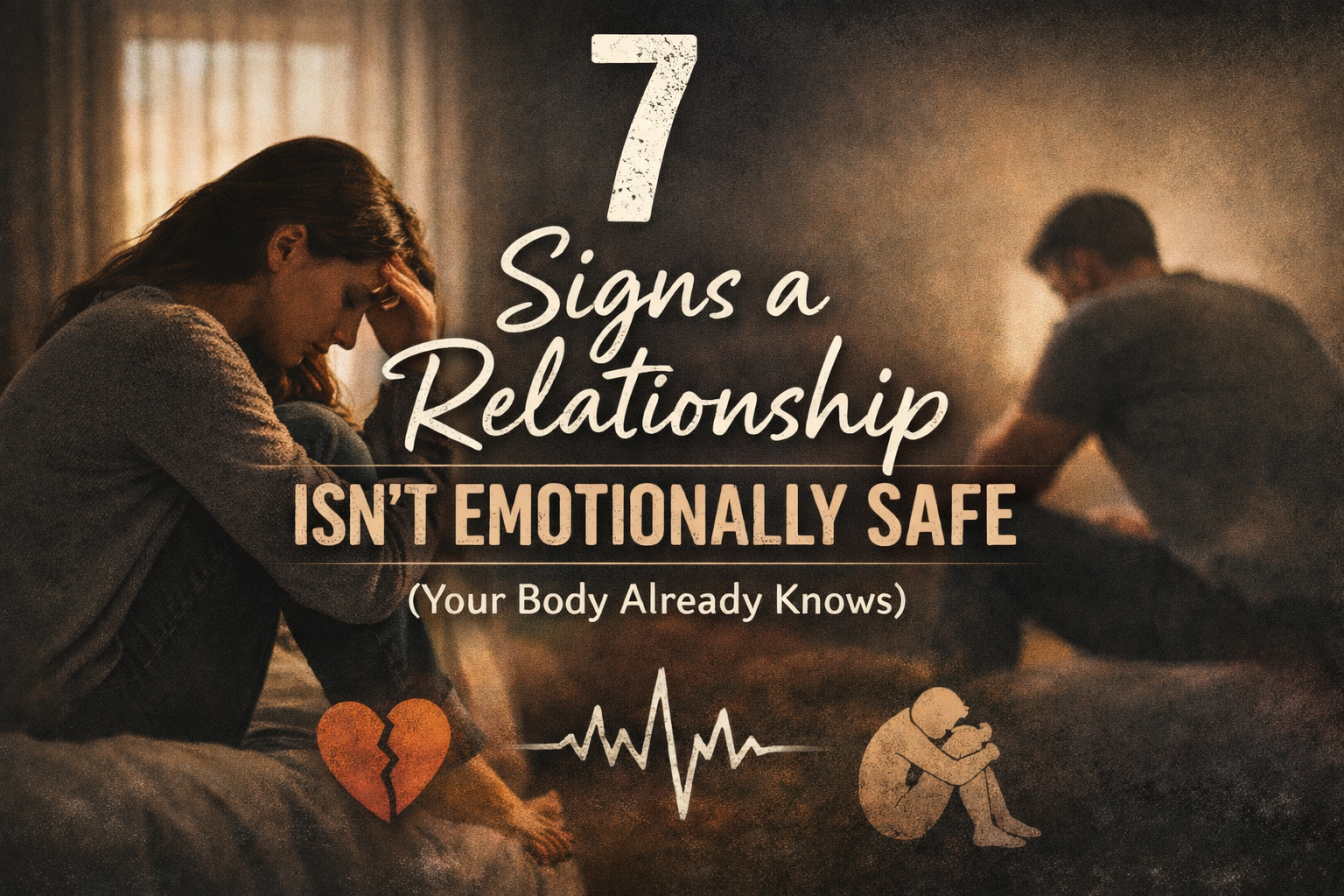
If you are searching for signs a relationship is not emotionally safe, something already feels off. You may still love them. You may still hope it works. But your body has started reacting in ways you cannot ignore. Tight chest. Poor sleep. Anxiety before they text.
Emotional safety in relationships is not a luxury. It is a requirement. When safety disappears, your nervous system shifts into protection mode. You start adapting instead of thriving.
This article will help you recognize when your body is signaling emotional danger, understand why that response happens before logical clarity, and decide what comes next with grounded confidence.
Your body does not guess. It scans for safety.
Let’s talk about what it has been trying to tell you.
Why the Nervous System Speaks First
Your brain analyzes.
Your nervous system reacts.
The body detects tone changes, inconsistency, withdrawal, and subtle rejection in seconds. You do not need proof yet. You feel it.
When emotional safety exists, your body relaxes. When it does not, your body prepares for threat.
That preparation shows up as:
• Muscle tension
• Digestive shifts
• Restlessness
• Hypervigilance
• Emotional shutdown
You may call it anxiety.
You may call it overthinking.
But your system asks one question only.
Am I safe here?
If the answer feels uncertain, your body activates.
Sign 1: You Feel Anxious Before Contact
Notice your reaction when their name appears on your phone.
Do you soften or brace?
Bracing matters. It means your nervous system expects impact.
Healthy relationships create steadiness, even during conflict. You do not rehearse every word before replying.
Client Example
A client named Alina told me she loved her partner. Yet every time he texted, her stomach dropped. She rewrote messages three times before sending them.
When we explored why, she realized he often responded with sarcasm or subtle criticism. He called it joking. Her body did not.
Her anxiety was not random. It was pattern recognition.
Your body tracks behavior faster than your heart lets go.
Sign 2: You Edit Yourself to Keep the Peace
You avoid certain topics.
You soften opinions.
You shrink reactions.
You tell yourself this is maturity.
It is not.
Compromise does not require self-erasure.
When you filter your personality to avoid conflict, your nervous system learned honesty leads to punishment.
That adaptation drains you over time.
Client Example
Jason described himself as “easygoing.” His partner described him as “emotionally distant.”
In session, he admitted he stopped sharing frustrations because she cried or accused him of attacking her.
He chose silence to prevent escalation.
His body stayed tense anyway.
When self-expression feels dangerous, emotional safety has weakened.
Sign 3: You Feel Relief When They Leave
This sign confuses people.
You miss them deeply.
Yet when they leave the room, your body exhales.
Relief signals pressure.
If your nervous system relaxes in their absence, it feels safer without the stimulus.
Client Example
Maya adored her boyfriend. She planned her future with him.
Yet she slept better on nights he stayed home. She felt lighter after arguments ended simply because he left the apartment.
Over time, she recognized the pattern. He criticized small habits daily. Not extreme. Not explosive. Constant.
Her system stayed alert.
Relief told the truth she avoided.
Sign 4: Your Sleep Changes
Sleep disruption reveals internal stress.
You wake replaying conversations.
You dream about abandonment.
You struggle to fall asleep after conflict.
In emotionally safe relationships, repair follows disagreement. Your body settles.
When repair never fully lands, your system stays activated.
Chronic activation leads to fatigue and emotional burnout.
Your body cannot rest where it does not trust stability.
Sign 5: You Doubt Your Reality
You question your memory.
You second-guess reactions.
You apologize before expressing pain.
Subtle dismissal erodes clarity.
If someone minimizes your feelings repeatedly, your nervous system becomes hyper-alert. You monitor every interaction.
Client Example
Lena said, “Maybe I am too sensitive.”
Her partner often told her she misinterpreted tone. He insisted she imagined tension.
In session, we reviewed specific conversations. Patterns emerged. He deflected responsibility and reframed her reactions as the problem.
Her body reacted because reality kept shifting.
Confusion is not always insecurity. Sometimes it signals emotional manipulation.
Sign 6: Conflict Feels Like Threat
Healthy disagreement includes discomfort. It does not include fear.
If arguments trigger shaking, nausea, or shutdown, your system perceives danger.
That reaction may connect to past trauma. It may also connect to present behavior.
Ask yourself:
Does this person escalate?
Do they threaten withdrawal?
Do they mock vulnerability?
Your body responds to patterns, not promises.
Sign 7: You Feel Smaller Over Time
Safety expands identity.
Unsafety contracts it.
Look at who you were before the relationship.
Were you more expressive?
More confident?
More open?
Chronic contraction leads to numbness or exhaustion.
Client Example
Daniel described himself as ambitious before his relationship. Two years later, he avoided applying for promotions because his partner mocked his goals.
He laughed it off publicly.
Privately, his body carried tension daily.
Growth requires encouragement. Safety allows expansion.
The Difference Between Attachment Anxiety and Intuition
Many people fear they sabotage relationships. They assume anxiety equals insecurity.
Distinguish the response.
Attachment anxiety seeks reassurance even in stable environments.
Intuition signals pattern-based inconsistency.
Test this gently.
When you create space, does anxiety spike or decrease?
If distance increases panic, attachment drives the reaction.
If distance brings calm, your nervous system needed relief.
Client Example
Serena believed she feared intimacy. After one week of emotional space from her partner, she slept through the night for the first time in months.
Her body answered clearly.
Calm reveals truth.
Why Emotional Fallout Feels So Intense
Admitting unsafety hurts.
You grieve potential.
You grieve effort.
You grieve who you hoped they would become.
Emotional fallout feels sharp because your system invested heavily in adaptation.
You tried to regulate two nervous systems at once.
That exhaustion catches up when clarity arrives.
The Cost of Ignoring Your Body
Chronic emotional stress affects:
• Hormone balance
• Focus
• Immunity
• Self-worth
Your body treats emotional unpredictability like physical threat.
Long-term exposure erodes resilience.
You stop recognizing yourself.
What Emotional Safety Feels Like
Emotional safety includes:
• Predictable behavior
• Accountability
• Repair after conflict
• Freedom to express needs
• Calm most of the time
Not perfection.
Consistency.
Your body feels grounded instead of guarded.
How to Move Forward with Clarity
If this resonates, slow down. Decisions made in panic rarely feel stable.
Step 1: Track physical responses for one week. Write down when tension appears and when calm returns.
Step 2: Separate hope from evidence. Look at repeated behavior, not isolated apologies.
Step 3: Strengthen external support. Spend time with people who create steadiness in your system.
Step 4: Reduce emotional overexposure. Limit circular arguments. Protect your energy while you evaluate.
Clarity grows in safety.
You are not dramatic.
You are not too sensitive.
You are perceptive.
Your body reads what your mind postpones.
If your nervous system feels contracted, anxious, or chronically alert around someone who claims to love you, pause.
Love without safety creates survival.
And you deserve more than survival.
You deserve calm.
You deserve respect.
You deserve relationships where your body rests instead of braces.
If you need support interpreting what your nervous system has been signaling and deciding your next steps, seek grounded guidance. Clarity becomes easier when you stop fighting your own body.
Your body knew first.
