
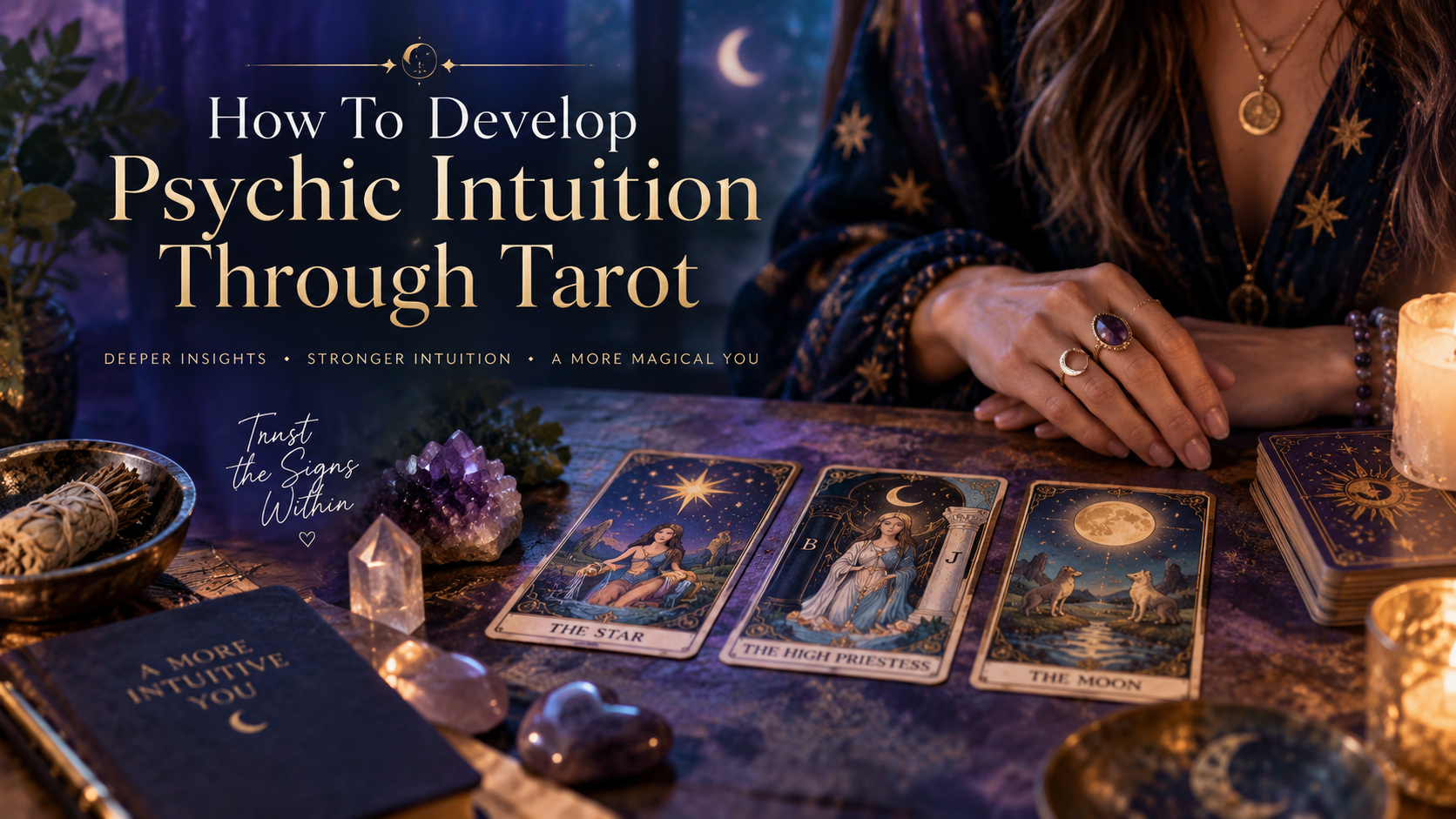
How To Develop Psychic Intuition Through Tarot
Have you ever looked at a tarot card and felt something before you remembered its traditional meaning?
Perhaps your attention went straight to one tiny symbol. A certain color seemed unusually important. Someone’s face suddenly appeared in your mind. An emotion rose in your chest before you understood why.
Those moments matter.
Psychic intuition often speaks before your logical mind gets involved. Tarot gives those impressions somewhere to land.
Learning card meanings helps you build a strong tarot foundation. Developing intuition takes your readings further. Instead of relying only on memorized definitions, you begin noticing feelings, images, words, physical sensations, memories, and inner knowing.
Your readings start feeling personal.
A card stops representing one fixed definition. Its message starts changing according to the person, question, surrounding cards, and energy of the reading.
Perhaps you pull the Eight of Cups during a relationship reading. A guidebook might talk about walking away. Your intuition might immediately tell you someone feels emotionally exhausted but has not decided to leave yet.
Both pieces of information matter.
Tarot knowledge gives you structure. Psychic intuition helps you interpret what the structure means in the present situation.
Developing this connection does not require forcing yourself to receive dramatic visions. Quiet impressions often provide the strongest messages.
Sometimes the first thought entering your mind carries more value than five minutes of analyzing every symbol.
Learning to trust those first impressions changes the way you read tarot.
Feeling confused about a relationship, career decision, emotional situation, or next step? A private psychic reading gives you personal insight into the energy surrounding your situation. Book your psychic reading today and receive direct guidance created around your questions.
How Tarot Helps Develop Psychic Intuition
Tarot offers one of the most practical ways to develop psychic intuition because each card gives your intuitive mind something visual to respond to.
Images activate thoughts.
Colors create emotional reactions.
People inside the cards suggest personality traits.
Objects draw attention toward hidden themes.
Symbols trigger personal associations.
Your intuition starts connecting these details with the energy of the question.
Anyone searching for how to develop psychic intuition through tarot often assumes psychic development involves predicting future events immediately. A stronger foundation begins with observation.
First, notice.
Next, feel.
Then, interpret.
Finally, verify.
Repeated tarot practice teaches you to recognize your personal intuitive language.
One reader might receive information through mental pictures. Another person notices physical sensations. Someone else hears words internally. A different reader experiences instant knowing without understanding where the information came from.
No single intuitive style needs to dominate your readings.
Different forms of psychic perception often work together.
Tarot provides a structured environment where you get to practice recognizing those impressions without demanding perfection from yourself.
What Is Psychic Intuition?
Psychic intuition refers to impressions arising beyond deliberate logical analysis.
A person might enter your mind unexpectedly during a reading. Specific words might appear. Your stomach might tighten while looking at one card. You might suddenly feel excitement even though the card traditionally carries a serious meaning.
Such reactions deserve attention.
Intuition often feels immediate.
Overthinking usually develops afterward.
Suppose you pull the Three of Swords while asking about someone’s feelings.
Traditional interpretations include heartbreak, grief, painful truth, separation, or emotional wounds.
During your reading, though, you immediately feel regret.
Regret becomes your intuitive clue.
Instead of automatically telling someone, “This person feels heartbroken,” you explore the impression.
You might interpret the card as someone regretting an action, feeling guilty about hurting another person, or processing an old emotional wound.
Tarot knowledge gives you the category.
Intuition gives you the detail.
Why Tarot Works So Well for Psychic Development
Tarot contains people, landscapes, colors, numbers, elements, gestures, animals, clothing, weather, architecture, plants, and spiritual symbols.
Every detail creates an opportunity for intuitive interpretation.
Pictures bypass part of the analytical process.
Imagine pulling The Hermit.
Your eyes might focus on the lantern.
Someone else notices the mountain.
Another reader immediately looks at the darkness surrounding the figure.
Each focus leads toward a different intuitive message.
The lantern might represent guidance.
A mountain might suggest a difficult personal journey.
Darkness might point toward uncertainty.
Your first visual attraction often deserves exploration.
Instead of asking, “What does this card mean?”
Try asking, “Why did my attention go there first?”
That question changes tarot reading from memorization into communication.
Learn Traditional Tarot Meanings First
Intuitive tarot does not mean ignoring traditional card meanings.
Structure strengthens intuition.
Understanding the suits, numbers, court cards, Major Arcana, elements, and basic card meanings gives your mind a reference point.
Consider learning the overall energy first.
Wands connect with action, passion, creativity, motivation, and drive.
Cups relate to emotions, relationships, intuition, love, and connection.
Swords involve communication, thoughts, conflict, decisions, truth, and mental patterns.
Pentacles connect with money, work, security, health, resources, and the physical world.
Major Arcana cards usually point toward larger lessons, personal growth, significant shifts, or important stages.
Court cards often represent people, personality traits, attitudes, or ways of approaching a situation.
Once you understand those foundations, intuition starts adding layers.
Think of tarot knowledge as your vocabulary.
Psychic intuition creates the conversation.
Start With One Card Instead of Large Spreads
Beginners often pull too much information at once.
A ten-card spread might look exciting, yet interpreting ten cards while learning psychic intuition creates unnecessary mental noise.
Start with one card.
Shuffle while focusing on a simple question.
Ask:
What energy surrounds me today?
What deserves my attention?
What lesson should I focus on?
What am I overlooking?
What emotional pattern needs awareness?
Pull one card.
Before reaching for a guidebook, sit with the image.
Notice your first reaction.
Write down anything entering your awareness.
Avoid judging the impression.
A strange thought might become meaningful later.
Perhaps you pull the Six of Pentacles and immediately think about someone asking for help.
Record it.
Later in the day, a friend contacts you asking for advice.
Experiences like this teach you how your intuition communicates.
Use the First Impression Exercise
One of the strongest tarot intuition exercises takes less than one minute.
Pull a card face up.
Give yourself ten seconds.
Write your first five impressions.
Examples include:
Cold.
Waiting.
Money.
Older man.
Message.
Do not interpret yet.
Afterward, study the card.
Ask why each impression appeared.
Perhaps “cold” came from the colors.
Waiting might come from the figure’s posture.
Money might relate to Pentacles.
An older man might appear mentally even though no older man appears on the card.
Message might feel completely unrelated to the traditional meaning.
Those unexplained impressions deserve extra attention.
Psychic information does not always arrive through obvious symbolism.
A thought appearing from nowhere often provides the clue worth exploring.
Pay Attention to Your Body During Tarot Readings
Your body often reacts before your mind forms an interpretation.
You might experience:
Pressure in your chest.
Butterflies in your stomach.
Warmth in your hands.
Tension around your shoulders.
A sudden chill.
A feeling of heaviness.
Unexpected excitement.
A sense of peace.
Physical reactions offer another layer of intuitive information.
Suppose you ask whether a relationship feels emotionally safe.
The Ten of Cups appears, yet your stomach tightens.
Traditional imagery looks positive.
Your physical reaction tells you to explore further.
Pulling a clarifying card might reveal hidden conflict, fear, or uncertainty.
Never force physical sensations into predictions. Instead, treat them as prompts for deeper interpretation.
Ask yourself what the sensation reminds you of.
Does tension feel like anxiety?
Does warmth feel comforting?
Does heaviness feel like emotional exhaustion?
Over time, patterns emerge.
Your body develops its own intuitive vocabulary.
Notice Which Part of the Tarot Card Pulls Your Attention
Every tarot card contains several visual elements.
Your attention rarely lands everywhere at once.
Something usually attracts you first.
Look at The Lovers.
Perhaps you notice the couple.
Another day, the mountain behind them draws your attention.
During a different reading, the angel becomes impossible to ignore.
A single card produces different messages depending on your focus.
When the couple stands out, relationships or partnership might matter.
A mountain could represent an obstacle or growth.
The angel might suggest spiritual guidance or a larger lesson.
Your eyes often follow your intuition.
Before interpreting a card, ask:
Where did I look first?
What did I notice second?
Which detail feels important?
What part of the card feels emotionally charged?
Those questions train your awareness.
Use Tarot to Strengthen Clairvoyance
Clairvoyance relates to receiving intuitive information through images, symbols, scenes, colors, or mental pictures.
Tarot works beautifully for visual intuitive practice.
Choose one card.
Study it for thirty seconds.
Close your eyes.
Recreate the image mentally.
Next, allow the picture to change.
Perhaps the person starts walking.
An object moves.
A door opens.
Someone enters the scene.
The weather changes.
Observe without controlling the story.
Afterward, write down what you saw.
This exercise trains your mind to notice spontaneous imagery.
Avoid worrying about whether every image carries psychic significance.
Practice develops discernment.
Repeated patterns eventually show you which impressions tend to carry useful information.
Use Tarot to Strengthen Clairaudience
Clairaudience refers to receiving intuitive information through words, phrases, sounds, names, or internal messages.
Pull a tarot card.
Look at the image.
Ask one question:
What message does this card want me to hear?
Remain quiet for a moment.
A sentence might pop into your mind.
Write the exact wording.
Perhaps you pull the Two of Swords and hear, “Stop avoiding the conversation.”
A guidebook might describe indecision.
Your clairaudient impression gives you a more specific direction.
Another reading might bring a name, lyric, phrase, or single word.
Record whatever arrives before analyzing it.
Words often disappear quickly once the logical mind starts questioning them.
Use Tarot to Strengthen Clairsentience
Clairsentience involves intuitive feelings and physical sensations.
Choose a card containing a person.
Look at the figure.
Ask yourself:
How does this person feel?
Avoid using the card meaning at first.
Read the posture.
Study the facial expression.
Notice the environment.
Sense the emotional atmosphere.
Perhaps the Queen of Cups feels peaceful during one reading.
During another reading, she feels lonely.
A third reading might make her seem protective.
The traditional archetype stays similar while the emotional message shifts.
Clairsentience helps you notice those changes.
Tarot questions often become harder when your own emotions sit inside the situation. If you feel stuck between intuition, fear, hope, and overthinking, a private psychic reading offers an outside perspective. Book your reading and get focused insight into what your situation looks like right now.
Separate Intuition From Anxiety
One of the hardest parts of psychic development involves telling intuitive impressions apart from emotional fear.
Intuition usually arrives quickly.
Anxiety tends to repeat itself.
Intuition often feels simple.
Fear creates long mental stories.
Intuition gives information.
Anxiety demands reassurance.
Suppose you ask whether someone will contact you.
Before pulling a card, your mind repeats:
What if they never call?
What if they found someone else?
What if I ruined everything?
Those thoughts come from emotional involvement.
Now imagine pulling the Page of Wands and immediately thinking, “Message.”
The first clean impression deserves attention.
Your emotional reaction afterward belongs in a different category.
Keeping a tarot journal helps you separate those patterns.
Keep a Psychic Tarot Journal
A tarot journal becomes one of your strongest psychic development tools.
Record:
Date.
Question.
Cards pulled.
Traditional meanings.
First impressions.
Physical sensations.
Images received.
Words received.
Emotional reaction.
Final interpretation.
Outcome later.
The outcome section matters.
Checking what happened teaches you which intuitive impressions proved useful.
You might notice repeating patterns.
Perhaps ringing sensations appear before communication-related developments.
A certain color might repeatedly connect with career readings.
The Knight of Wands might repeatedly represent a particular personality type for you.
Your personal tarot language develops through experience.
Someone else’s interpretation does not replace your own accumulated evidence.
Use Tarot Without Looking at the Card Meaning
Try this exercise once you know the basic deck structure.
Pull a card.
Do not look up the meaning.
Write an interpretation using only:
Color.
Facial expression.
Body language.
Objects.
Direction.
Background.
Weather.
Your emotional response.
Next, compare your interpretation with the traditional meaning.
Notice overlaps.
You might feel surprised by how much you already sensed.
This method teaches you to trust observation before reaching for outside interpretation.
Read the Story Between Multiple Tarot Cards
After becoming comfortable with single cards, move into three-card readings.
Lay three cards beside each other.
Instead of interpreting each card separately, create one story.
Ask:
What changed from card one to card two?
Where are the figures looking?
Do the colors become lighter or darker?
Does the energy become more active?
Which card feels strongest?
What emotion connects all three?
Where does the story seem to be going?
Suppose you pull:
Five of Cups.
The Star.
Ace of Cups.
Reading each card separately gives you grief, hope, and emotional beginnings.
Reading the story gives you something richer.
Someone moves from disappointment toward healing before opening emotionally again.
Your intuition starts reading movement rather than isolated definitions.
This skill becomes especially useful in relationship readings.
Practice Tarot Predictions With Low-Stakes Questions
Psychic intuition grows through feedback.
Low-stakes questions provide easy practice.
Ask questions such as:
What energy will dominate my day?
What type of conversation will stand out today?
What should I notice during my errands?
What energy surrounds tomorrow’s plans?
Which part of my work needs attention?
Avoid testing yourself with emotionally intense predictions every day.
Small questions reduce pressure.
Suppose you pull the Eight of Wands in the morning.
You interpret fast communication.
Later, several messages arrive close together.
Write down the result.
Perhaps you pull Four of Swords instead.
The day becomes quiet and you spend extra time resting.
Record this too.
Consistent feedback strengthens your confidence.
Avoid Pulling Repeated Cards for the Same Question
Repeating a question often weakens intuitive clarity.
Imagine asking:
Does this person miss me?
You pull the Six of Cups.
Then you doubt yourself.
You shuffle again.
The Hermit appears.
You ask again.
The Seven of Cups arrives.
Soon, confusion replaces insight.
Your first spread gave you information.
Extra pulls introduced additional layers your emotional mind did not need.
When a reading feels unclear, clarify the interpretation rather than restarting the entire question.
Ask:
What does the Six of Cups represent here?
A focused clarification keeps the reading connected to the original message.
Give Your Intuition Space Before Checking a Guidebook
Guidebooks help you learn tarot.
Using one too quickly sometimes interrupts intuitive impressions.
Try giving yourself two minutes before checking outside meanings.
Write everything you sense.
Then read the traditional interpretation.
Compare both.
You might discover your first impression aligns closely with the conventional meaning.
Other times, your interpretation adds emotional detail.
Occasionally, your message looks completely different.
Do not automatically discard it.
Record the impression and see whether later events explain it.
Accuracy develops through observation over time.
Create a Personal Symbol Dictionary
Psychic intuition often communicates through repeated symbols.
Certain images might hold unique meanings for you.
Rain might represent emotional release.
A red rose might connect with romance.
Keys might signal access or opportunity.
A train might suggest movement.
Birds might represent communication.
Your symbols do not need to match another psychic reader’s symbols.
Keep a section inside your tarot journal for repeating images.
Write the symbol beside situations where it appeared.
Patterns eventually become clear.
Your intuitive vocabulary becomes easier to recognize.
Practice Reading Tarot for Other People
Reading yourself teaches valuable skills.
Reading other people often accelerates psychic development because you have less emotional attachment to the outcome.
Ask a trusted friend for a question.
Avoid requesting the entire story before you begin.
Pull three cards.
Share what you notice.
Start with impressions.
You might say:
“I keep feeling a delay around this.”
“This person feels guarded.”
“I keep getting something connected with work.”
“The cards make me feel someone has not said everything yet.”
Allow your friend to respond afterward.
Feedback helps you discover which impressions connect accurately.
Avoid fishing for agreement.
State what you receive and let the information stand.
Confidence develops through practice, not constant validation.
Learn How Your Psychic Intuition Feels
Each person experiences intuition differently.
Your strongest style might involve sight.
Someone else relies on feelings.
Another reader receives sudden knowledge.
Others hear phrases internally.
Notice your first response during readings.
Do you see something?
Do you feel something?
Do you hear something?
Do you simply know?
Understanding your natural style helps you strengthen it.
You do not need every psychic sense to work equally.
Develop the channels appearing most naturally first.
Stop Trying to Force Psychic Messages
Pressure interferes with intuitive reading.
Trying desperately to receive something often pushes your mind toward invention.
Instead, observe.
Silence gives intuition room.
Pull your card.
Look at it.
Wait.
Notice what arrives.
Nothing dramatic needs to happen.
A subtle thought has value.
A mild physical sensation matters.
A memory might contain a clue.
One word might lead the entire reading.
Psychic intuition often feels quieter than people expect.
Let Tarot Questions Stay Specific
Clear questions create clearer readings.
Instead of asking:
What is happening with my life?
Try:
What energy surrounds my career during the next month?
Replace:
What does this person think?
With:
What energy currently influences this person’s thoughts about our connection?
Switch:
Will everything work out?
To:
What should I understand about the direction of this situation?
Specific questions focus your intuition.
They also make later verification easier.
Use a Three-Card Psychic Intuition Spread
Try this simple spread whenever you want to practice reading beyond memorized definitions.
Card One: What I Already Know
This position reveals what your conscious mind already understands.
Card Two: What My Intuition Is Picking Up
Focus strongly on your first impressions here.
Card Three: What I Need to Trust
The final card highlights the insight worth carrying forward.
Before interpreting the traditional meanings, write three intuitive words beside each card.
Next, look for connections.
Finish by writing one paragraph describing the entire message.
Repeat this spread once a week.
Comparing entries over several months shows how your intuition changes.
Practice With Tarot Cards Face Down
Another exercise removes visual influence.
Shuffle your deck.
Select one card.
Leave it face down.
Hold your hand above it.
Ask yourself:
Does the energy feel active or quiet?
Does it feel emotional or practical?
Does it feel heavy or light?
Which tarot suit comes to mind?
Does the card feel like Major or Minor Arcana?
Write your impressions.
Turn the card over.
Avoid scoring yourself only as right or wrong.
Look for thematic matches.
You might guess Cups while pulling The Moon.
Technically, The Moon belongs to the Major Arcana.
Emotionally and intuitively, the watery association still makes sense.
Psychic development involves learning connections, not passing a test.
Read Colors Intuitively
Color creates immediate emotional associations.
Red might suggest action, passion, anger, attraction, courage, or urgency.
Blue often brings thoughts of communication, peace, sadness, truth, or spirituality.
Green frequently connects with growth, money, healing, nature, or stability.
Yellow might represent confidence, awareness, optimism, attention, or mental activity.
Black sometimes points toward mystery, protection, endings, fear, or the unknown.
White often suggests clarity, cleansing, innocence, simplicity, or spiritual focus.
Your personal reaction matters more than memorizing one color dictionary.
Ask what each color means to you inside the reading.
Notice Direction and Movement in the Cards
Tarot figures often look toward or away from other cards.
Direction creates meaning.
Imagine the Queen of Cups facing the Knight of Pentacles.
The visual connection might suggest emotional interest toward someone moving slowly.
Reverse their positions and the Queen looks away.
Now the story changes.
Movement also matters.
A Knight rushing toward another card creates a different message from someone sitting still.
Cards appearing to move away from conflict might suggest withdrawal.
Figures looking toward the past position might indicate unfinished business.
Use the whole spread as one visual scene.
Let the cards interact.
Work With Court Cards Intuitively
Court cards confuse readers because they carry several possible meanings.
Instead of immediately deciding whether a court card represents a specific person, ask:
Does this feel like a person?
Does this feel like an attitude?
Does this represent the person asking the question?
Does someone in my life resemble this energy?
Which personality traits stand out?
Pages often bring learning, curiosity, news, or youthful energy.
Knights bring movement, pursuit, action, or changing momentum.
Queens often express internal mastery, emotional intelligence, receptivity, or mature qualities.
Kings frequently represent authority, outward mastery, leadership, responsibility, or established energy.
Your intuition helps determine which interpretation fits the question.
Notice Tarot Cards Repeating
Repeated cards deserve attention.
Perhaps The High Priestess appears several times during one week.
Instead of treating every appearance as unrelated, track the pattern.
Ask what theme keeps returning.
The High Priestess might encourage deeper trust in your intuition.
Eight of Pentacles might point toward practice and skill development.
Two of Swords might highlight avoidance.
The Tower might show a structure requiring change.
Repetition gives your intuitive mind another way to recognize themes.
Build a Tarot Ritual Before Readings
A simple routine helps your mind transition into reading mode.
Keep it practical.
You might:
Take three slow breaths.
Hold the deck.
State your question.
Clear unnecessary distractions.
Shuffle until you feel ready.
Pull your cards.
Pause before interpreting.
Your ritual does not need elaborate tools.
Consistency tells your mind it is time to focus.
A calm environment often makes subtle impressions easier to notice.
Trust Your Reading Before Seeking Another Opinion
Constantly comparing your interpretation with other tarot readers weakens confidence.
Study other perspectives for education.
Avoid using them to erase your own impressions.
Suppose your interpretation feels different from what you find online.
Ask why.
Your question might change the meaning.
Surrounding cards might shift the message.
Your intuitive response might highlight one specific part of the card.
Tarot contains layers.
Different readings do not automatically mean one person read incorrectly.
Developing Psychic Intuition Takes Practice
One reading will not define your ability.
Repeated practice teaches you what intuition feels like.
Some sessions feel clear.
Others feel quiet.
Certain days produce strong imagery.
Another day might bring mostly emotional sensations.
Energy, focus, stress, expectations, and emotional involvement affect how easily you interpret tarot.
Keep practicing without demanding perfect results.
Consistency matters more than intensity.
Ten focused minutes each day gives you regular contact with the cards.
Eventually, symbols feel familiar.
Connections form faster.
First impressions become easier to recognize.
Your confidence grows because experience replaces guessing.
Common Mistakes When Developing Psychic Intuition Through Tarot
Relying Only on Memorized Meanings
Traditional knowledge matters, yet rigid interpretation limits your reading.
Allow each card to respond to the question.
Ignoring Your First Impression
Your first reaction often disappears once analysis begins.
Write it down immediately.
Pulling Too Few Clarifiers With Purpose
Clarifying cards work best when each one answers a specific follow-up question.
Random extra cards create noise.
Pulling Too Many Cards
Large spreads overwhelm developing intuition.
Use one to three cards while practicing.
Reading While Highly Emotional
Strong fear or hope sometimes colors interpretation.
Journal your feelings before reading emotionally charged questions.
Expecting Dramatic Psychic Experiences
Intuition often arrives quietly.
Notice small impressions.
Comparing Yourself With Other Readers
Your psychic language develops through your own experiences.
Track your results instead.
Changing the Question Repeatedly
Constant rewording produces conflicting readings.
Choose one clear question and stay with it.
Psychic Intuition and Tarot Confidence
Confidence does not mean believing every thought entering your mind.
Strong intuitive reading includes discernment.
Ask yourself:
Did this impression arrive before I started analyzing?
Does it fit the question?
Do surrounding cards support it?
Have I experienced this type of impression before?
Does the message feel clear or emotionally charged?
Checking these points strengthens your judgment.
Over time, you learn which impressions deserve more attention.
Tarot becomes less about finding the “correct” definition and more about understanding the message created by the entire reading.
A Practical 7-Day Tarot Intuition Challenge
Day One: First Impressions
Pull one card.
Write five immediate impressions before looking up the meaning.
Day Two: Body Awareness
Choose one card and notice every physical sensation arising while studying it.
Day Three: Clairvoyance
Study a card, close your eyes, and observe any mental images developing.
Day Four: Clairaudience
Ask your card for one sentence of guidance.
Write the first phrase entering your awareness.
Day Five: Story Reading
Pull three cards and turn them into one connected story.
Day Six: Face-Down Intuition
Choose a card without looking.
Sense its emotional tone before turning it over.
Day Seven: Verification
Review your journal from the previous six days.
Highlight impressions matching events, emotions, conversations, or situations you experienced.
Seven days will not complete psychic development.
The challenge will help you identify how your intuition already communicates.
How Tarot Changes When You Start Trusting Your Intuition
Eventually, readings start flowing differently.
You stop staring at cards while searching your memory for definitions.
Instead, ideas begin connecting naturally.
One symbol reminds you of a person.
A color creates an emotion.
The next card explains why.
Another card shows where the situation appears to be heading.
Your knowledge and intuition start working together.
Tarot begins feeling like a language rather than a collection of separate meanings.
Most importantly, you become more comfortable trusting your first impressions while still checking them against context.
That balance creates stronger readings.
You keep your tarot foundation.
You also give your psychic intuition space to speak.
Final Thoughts on How To Develop Psychic Intuition Through Tarot
Tarot offers a practical way to strengthen psychic intuition because it combines symbols, emotions, stories, and personal interpretation.
Start small.
Pull one card.
Notice where your eyes go.
Pay attention to your body.
Write down your first thought.
Track unusual words or images.
Study traditional meanings afterward.
Keep a journal.
Review your results.
Practice with other people.
Give yourself time to recognize patterns.
Your goal does not involve receiving dramatic messages during every reading.
Instead, learn your intuitive language.
Once you recognize how your intuition speaks, trusting it becomes easier.
Tarot gives you the opportunity to practice this connection again and again.
Every card becomes another conversation.
Every reading gives you more feedback.
Every journal entry strengthens your awareness.
Psychic intuition grows through attention, practice, trust, and experience.
The more carefully you listen, the easier it becomes to recognize the difference between memorized meaning, emotional fear, random thought, and genuine intuitive insight.
If you feel uncertain about love, relationships, career decisions, personal direction, or a situation you cannot seem to read clearly on your own, book a private psychic reading with me.
Together, we will look at the energy surrounding your situation, uncover what deserves your attention, and explore your next steps.
You do not have to keep pulling card after card searching for clarity.
Book your psychic reading today and get direct insight into the questions weighing on your mind.
