
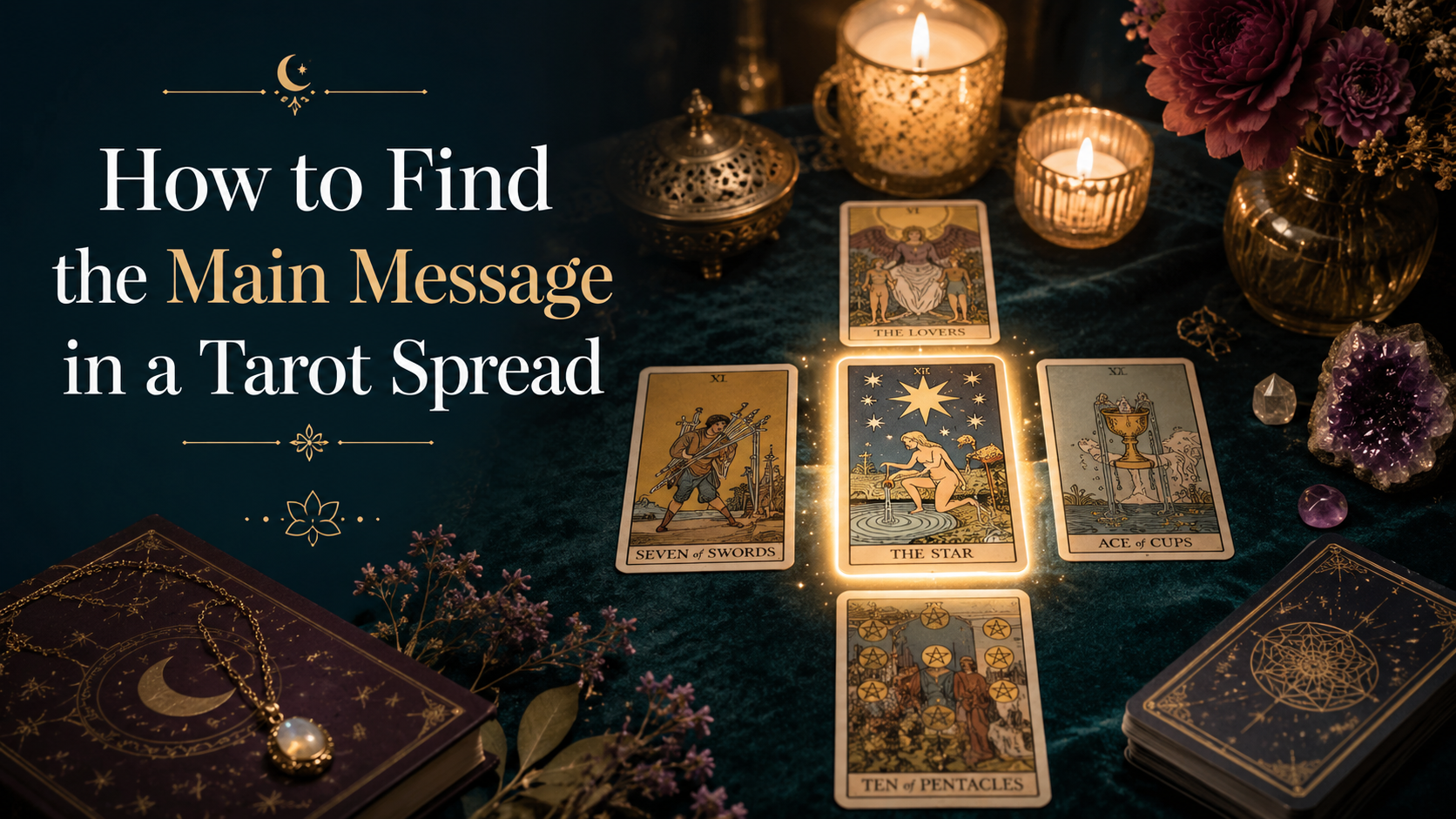
How to Find the Main Message in a Tarot Spread
You shuffle your tarot deck, ask your question, and lay the cards across the table.
Then you stare at them.
One card talks about change. Another points toward love. A third looks like conflict. A Major Arcana card appears beside a reversed court card. Suddenly, a reading you hoped would bring clarity leaves you more confused than before.
If you have ever looked at a tarot spread and thought, “I know what these cards mean individually, but what are they trying to tell me together?” you are experiencing one of the biggest challenges tarot readers face.
The problem usually has little to do with memorizing card meanings.
The challenge comes from finding the main message.
You might know the textbook meaning of every card in your spread and still struggle to explain what the reading says as a whole.
Strong tarot reading depends on connection.
You want to see which cards speak the loudest, what themes repeat, where the energy moves, and which details support the central story.
You also do not need to interpret every card with the same amount of attention.
Sometimes three cards tell most of the story.
One powerful Major Arcana card might reveal the turning point.
Several cards might repeat the exact same message in different ways.
When you learn how to find the main message in a tarot spread, readings start feeling clearer, easier, and more natural.
You stop sounding like you are reading definitions from a tarot book.
Instead, you begin telling the story the cards are showing you.
If you are struggling to understand a personal situation and want help seeing what your cards are revealing, book a private psychic and tarot reading with me. I will help you look beyond individual card meanings and understand the bigger message surrounding your relationship, career, personal path, or next steps.
What Is the Main Message in a Tarot Spread?
The main message is the central idea running through the reading.
Every card gives information, yet every card does not carry equal weight.
Imagine someone asks:
“Where is this relationship going?”
You pull:
The Hermit
Eight of Cups
Two of Swords
Six of Swords
The Star
You now have five separate card meanings available.
The Hermit relates to withdrawal and reflection.
Eight of Cups points toward emotional distance or walking away.
Two of Swords shows indecision or avoidance.
Six of Swords represents moving away from a difficult situation.
The Star brings healing, renewal, and hope.
Reading these cards one at a time gives useful information.
The bigger story matters more.
Four cards describe emotional distance, hesitation, withdrawal, and transition.
The Star shows healing after the difficult period.
The main message does not revolve around The Star alone.
Instead, the spread tells you someone appears to be moving through emotional separation before reaching a healthier place.
You might interpret the spread like this:
“This relationship seems to be entering a period of distance and reflection. Someone appears emotionally withdrawn and uncertain about what comes next. The cards show movement away from the current situation, followed by healing and greater clarity.”
That sounds much clearer than giving five separate definitions.
The reading has a beginning, middle, and direction.
Your first goal involves finding the story.
Start With the Question Before You Read the Cards
Always return to the original question.
A tarot card does not exist by itself.
Its meaning shifts depending on what someone asks.
Imagine pulling Four of Swords.
In a relationship reading, Four of Swords might point toward silence, emotional distance, or a temporary pause.
During a career reading, the same card might suggest stepping back, resting, or delaying a decision.
In a personal growth reading, Four of Swords might highlight mental recovery.
The question gives the card direction.
Before you study individual meanings, ask yourself:
“What does this person want to understand?”
Then read the spread through that lens.
If someone asks whether an ex will reconnect, avoid turning the reading into a career discussion because several Pentacles appear.
Pentacles in a relationship reading might describe stability, effort, priorities, security, time, routine, or practical obstacles.
Context comes first.
Look at the Whole Tarot Spread Before Reading Individual Cards
One of the strongest habits you can develop involves looking at the entire spread before interpreting anything.
Give yourself a few seconds.
Do not rush.
Notice what stands out.
Are there several Major Arcana cards?
Does one suit dominate?
Are several cards reversed?
Do several cards show people walking away?
Do the figures face one another?
Does one card feel completely different from the others?
Does the spread feel hopeful, tense, emotional, restless, heavy, or stagnant?
Your first visual reaction gives you useful information.
Imagine pulling:
Five of Cups
Three of Swords
Nine of Swords
Ten of Swords
The Sun
Four cards carry painful emotional energy.
The Sun brings warmth and clarity.
A reader who focuses too heavily on The Sun misses the dominant message.
Most of the spread speaks about pain, disappointment, worry, and an ending.
The Sun shows improvement after the difficult period.
One positive card does not erase four challenging cards.
The opposite also applies.
One difficult card does not ruin an otherwise supportive spread.
Look at the balance.
Find the Cards With the Strongest Energy
Some cards demand more attention than others.
Major Arcana cards often carry more weight because they point toward major lessons, turning points, or situations with deeper significance.
Contrast also matters.
Suppose someone asks about a relationship and pulls:
Two of Cups
Page of Cups
Six of Pentacles
The Tower
Knight of Cups
Most of the spread contains emotional connection, giving, and romantic energy.
Then The Tower appears.
The Tower stands out immediately.
Something disrupts the current situation.
A sudden truth might come out.
A confrontation might change the relationship.
Someone might experience a major realization.
The Tower deserves attention because its energy differs so strongly from everything around it.
Whenever one card feels dramatically different from the rest of the spread, ask why.
That difference often leads you toward the main message.
Pay Close Attention to Major Arcana Cards
Major Arcana cards often reveal the deeper lesson behind a reading.
A spread filled with Minor Arcana usually focuses more on everyday choices, emotions, conversations, and events.
Several Major Arcana cards suggest a bigger turning point.
Imagine someone asks whether they should leave a difficult job.
You pull:
Eight of Pentacles
Three of Pentacles
The Devil
Judgement
The Fool
The first two cards focus on work and effort.
Then the energy shifts.
The Devil points toward unhealthy attachment, fear, obligation, or feeling trapped. Usually we feel tied to the workplace
Judgement brings awakening and recognition.
The Fool introduces a new beginning.
The main message becomes much clearer.
This person appears to be reaching a major turning point involving freedom, choice, and a different direction.
Eight of Pentacles and Three of Pentacles still matter because it shows the effort they have put into it and what they have built while
working there. They describe the work situation.
The Devil, Judgement, and The Fool describe the bigger transformation. the fool is where we go with the flow and be open to new
opportunities. in this case, change and transformation is next step, and a new job will help with their growth and transformation.
Notice Which Tarot Suit Dominates the Spread
The four tarot suits help you understand where the strongest energy sits.
Cups focus on emotions, love, relationships, intuition, and connection.
Wands focus on action, passion, attraction, creativity, motivation, and movement.
Swords focus on thoughts, communication, decisions, conflict, fear, anxiety, and truth.
Pentacles focus on work, money, security, stability, health, effort, and practical matters.
When one suit appears repeatedly, pay attention.
Imagine someone asks:
“Why does this relationship feel distant?”
You pull:
Nine of Swords
Two of Swords
King of Swords
Five of Swords
Page of Cups
Four Swords surround one Cup.
The strongest problem appears mental rather than emotional.
Someone might be overthinking.
Communication might feel blocked.
Fear might be influencing behavior.
A person might be protecting themselves from conflict.
The Page of Cups suggests feelings still exist.
Emotion has not disappeared.
The Swords simply dominate the situation.
You might say:
“The distance seems connected more to thoughts and communication than a lack of feeling. Someone appears guarded and stuck in their head. Feelings remain present, yet fear, avoidance, or overthinking seems stronger right now.”
A dominant suit often reveals the center of the reading quickly.
Watch for Repeated Numbers
Repeated numbers strengthen themes.
Several Twos often point toward choices, partnerships, balance, or indecision.
Fours might show stability, structure, holding on, or restriction.
Fives often highlight conflict, instability, or change.
Sixes might point toward adjustment, movement, giving, recovery, or harmony.
Tens often speak about completion, endings, responsibility, or reaching the end of a cycle.
Suppose you pull:
Two of Cups
Two of Pentacles
Two of Swords
The Lovers
Three Twos appear.
Choice becomes an important theme.
Even though the spread involves romance, the deeper question might involve a decision within the relationship.
Repeated numbers do not require a long numerology explanation.
Notice the pattern.
Ask what those cards share.
Look for Themes That Repeat Without Matching Suits
Cards sometimes repeat the same idea without sharing a suit or number.
Imagine pulling:
The Hermit
Four of Swords
Eight of Cups
Six of Swords
Each card shows distance in a different form.
The Hermit withdraws.
Four of Swords pauses.
Eight of Cups leaves emotionally.
Six of Swords moves away from difficulty.
You do not need four unrelated interpretations.
The spread is repeating one message.
Distance matters.
Tarot often emphasizes important information through repetition.
When the same idea appears again and again, listen.
Watch Where the People in the Cards Are Looking
Direction adds another layer to tarot.
Look at the figures in your deck.
Who faces another person?
Who looks away?
Which figure seems to move toward a card?
Does someone appear to be leaving something behind?
Imagine pulling:
Queen of Cups
Knight of Cups
Eight of Cups
Suppose the Knight faces the Queen while the figure in Eight of Cups walks away.
The reading might show emotional interest mixed with withdrawal.
Placement changes the story.
Another spread might show:
Six of Swords
The Star
Ace of Cups
The cards visually suggest someone moving away from difficulty and toward healing and emotional renewal.
Tarot involves images as much as definitions.
Study what the pictures are showing you.
Find the Card Sitting at the Center of the Story
In larger spreads, the middle card sometimes acts as the anchor.
This approach does not apply to every tarot layout.
Still, the center often deserves attention.
Imagine a five-card spread:
Nine of Wands
Four of Pentacles
Death
Ace of Wands
Three of Wands
Death sits in the middle.
The cards before Death show resistance and holding on.
The cards after Death show fresh energy and movement.
Death becomes the bridge between the two phases.
The message centers on transformation.
Something needs to change before new progress starts.
The surrounding cards show what happens before and after that change.
Read Tarot Cards Like a Sentence
One of the easiest ways to find the main message in a tarot spread involves turning the cards into a sentence.
Take three cards:
Five of Cups
The Hermit
Ace of Cups
Instead of giving three definitions, connect them.
“After disappointment, someone withdraws to process their feelings before opening themselves to a new emotional beginning.”
Now the cards have movement.
Try another:
Seven of Pentacles
Knight of Wands
Eight of Wands
“After waiting for progress, someone takes action and events begin moving quickly.”
Ask yourself:
What happens first?
What happens next?
Where does the energy lead?
Those questions turn a group of cards into a story.
Stop Giving Every Tarot Card Equal Importance
This is one of the biggest lessons I teach tarot readers.
You do not need to explain every card with the same level of detail.
Some cards give background information.
Others confirm a message you already received.
A few cards add only one small detail.
One card might feel quiet.
Leave it alone for a moment.
You do not need to force an interpretation because the card sits on the table.
Sometimes the strongest message already came through three other cards.
Return to the quieter card after you understand the story.
Its role often becomes clearer.
Forcing a meaning usually creates confusion.
Let the cards speaking the loudest lead the reading.
It Is Fine If Only a Few Cards Carry the Main Message
A ten-card spread does not require ten long interpretations.
Sometimes two cards reveal almost everything you need.
Imagine asking whether someone plans to end a relationship.
You pull ten cards.
Death and Eight of Cups stand out immediately.
Several surrounding cards show stress, arguments, uncertainty, and exhaustion.
Death and Eight of Cups carry the central message.
The remaining cards explain why the change or departure appears.
This style of reading feels more intuitive because you stop treating tarot like a test.
Your job is to understand the message.
You do not need to prove how well you remember every card definition.
Pay Attention to the First Tarot Card
The first card often sets the tone.
Imagine asking:
“What should I know about this relationship?”
Seven of Swords appears first.
Trust, avoidance, secrecy, strategy, or hidden motives deserve attention.
Later cards might explain who feels guarded, what someone avoids, or why communication lacks openness.
Treat the first card as an introduction.
Do not treat it as the entire answer.
Pay Attention to the Final Tarot Card
The final card often shows where the energy leads.
Suppose a spread begins with conflict and ends with Six of Swords.
The situation appears to move toward distance, resolution, or leaving stress behind.
Another spread might begin with confusion and end with The Sun.
Clarity follows.
A spread might start positively and end with Ten of Swords.
Something reaches a difficult conclusion.
The final card helps you understand direction.
Connect it with everything leading toward it.
Notice Reversed Cards Without Letting Them Control the Reading
Reversed cards add another layer.
A reversal might show blocked energy, delays, internal feelings, imbalance, resistance, or an altered expression of the upright meaning.
Look at the pattern.
If nearly every card appears upright and one card lands reversed, ask why it stands out.
Imagine:
Three of Cups
Ten of Cups
Ace of Cups
Queen of Cups reversed
The Queen of Cups reversed might show one person struggling emotionally despite loving energy surrounding them.
Perhaps insecurity plays a role.
Someone might feel overwhelmed.
Another person might struggle to receive love.
The reversal adds detail without automatically changing the entire spread.
Ask Which Card Answers the Question Most Directly
This technique helps you avoid overcomplicating readings.
After laying out your cards, ask:
“Which card answers my question most directly?”
Suppose you ask:
“Will I hear from this person?”
You pull:
The Hermit
Four of Swords
Page of Wands
Eight of Wands
Three of Cups
Eight of Wands strongly points toward communication and fast movement.
Page of Wands also supports contact.
The Hermit and Four of Swords describe the silence before communication.
Three of Cups might show a warmer interaction afterward.
Now the story becomes simple.
Silence comes first.
Communication follows.
Social connection or reunion appears after.
You found the answer without turning five cards into five separate stories.
Separate the Main Message From Supporting Details
A strong tarot reading has layers.
Give the main answer first.
Then explain what supports it.
Imagine a client named Rachel asks why Daniel has stopped reaching out.
Her spread shows:
Four of Swords
Nine of Wands
King of Cups
Two of Swords
The Hermit
The central message involves withdrawal.
Four of Swords and The Hermit strongly support silence and distance.
Nine of Wands adds defensiveness.
Two of Swords shows avoidance or indecision. This is usually the wall is built up around him.
King of Cups points toward emotional control.
Instead of telling Rachel, “Daniel has no feelings,” the spread suggests emotional withdrawal and self-protection.
A clear interpretation might sound like this:
“Daniel appears withdrawn and guarded right now. He seems to be holding his feelings inside instead of acting on them. Indecision also seems to play a role in the silence.”
Then you explain the supporting details.
Giving the core message first keeps the reading easy to follow. but the truth is Daniel actually does not feel the same for Rachel as Rachel has for him. Sometimes speaking such truth can difficult which is why you can simplify the explanation without being too blunt since Rachel here may need news delivered gently.
If you are dealing with a confusing relationship and your tarot spread leaves you with more questions than answers, a private reading gives you space to look at the full situation. Book a private psychic reading with me when you want clear insight into someone’s feelings, intentions, relationship direction, or the choices in front of you.
Use Card Clusters in Larger Tarot Spreads
Large spreads become easier when you divide them into groups.
Imagine nine cards.
Perhaps cards one through three show conflict.
Cards four through six show withdrawal.
Cards seven through nine show renewed movement.
Now you have three clear phases.
Conflict.
Distance.
Movement.
You no longer need to process nine separate messages.
Clusters help you see the bigger picture.
Look for Cause and Effect
Tarot often shows why something happens.
Imagine:
Five of Wands
Nine of Swords
Four of Swords
Conflict leads toward worry.
Worry leads toward withdrawal.
Another example:
Three of Swords
Queen of Swords
Eight of Cups
Pain leads someone to protect themselves.
Emotional protection leads toward leaving.
Ask yourself:
“What led to the next card?”
This question often uncovers the story hiding inside a spread.
Notice the Emotional Progression
Feelings change throughout tarot spreads.
A person might move from fear into confidence.
Someone else might move from excitement toward disappointment.
A relationship might move from distance into reconnection.
Consider:
Nine of Swords
Strength
Queen of Wands
The energy moves from anxiety toward self-control and confidence.
The main message involves regaining personal power.
Another example:
Ace of Cups
Two of Cups
Five of Pentacles
The spread starts with emotional potential.
Connection develops.
Then someone ends up feeling left out or isolated.
The progression matters.
Do not assume one positive card guarantees a positive ending when the rest of the spread moves elsewhere.
Listen to Your First Intuitive Reaction
Before analyzing every detail, notice your first reaction.
Which card grabbed your attention?
What feeling came up?
What story entered your mind?
Perhaps you look at Eight of Cups and immediately feel someone is exhausted from trying.
The traditional meaning supports emotional departure.
Your intuition adds emotional context.
Write down your first impression before overthinking it.
Then compare your impression with the rest of the spread.
If several cards support the same feeling, you have found an important part of the message.
Do Not Force the Outcome You Want
Personal readings often become harder when emotions get involved.
If you hope for reconciliation, you might focus on every positive card as proof your ex is coming back.
If you fear rejection, you might read every difficult card as a permanent ending.
This is why the full pattern matters more than one card.
Imagine a client named Stephanie asks whether she and Michael will reconcile.
She pulls:
Six of Cups
Five of Cups
Two of Swords
Eight of Cups
The World
Six of Cups shows memories, nostalgia, and a strong connection to the past. The relationship still holds emotional meaning, and Michael might still think about what they shared.
Five of Cups brings sadness, regret, and disappointment.
Two of Swords shows uncertainty, avoidance, or difficulty making a clear decision.
Eight of Cups is one of the strongest cards in this spread because it points toward emotional withdrawal and moving on. Michael appears to be creating distance from the relationship rather than moving back toward it.
The World strengthens this message. It represents completion, closure, and the end of a cycle.
When you read all five cards together, the message becomes much clearer. Six of Cups shows lingering memories, but the rest of the spread moves toward separation and completion.
The relationship mattered. The memories remain. Yet the strongest pattern suggests the connection has reached the end of its current cycle.
This is why you should never let one hopeful card control the entire interpretation. The full spread tells the story.
Ask What Keeps Repeating
Whenever you feel lost, stop and ask:
“What message keeps appearing?”
Perhaps you keep seeing waiting.
Maybe you keep seeing silence.
Fear might repeat.
Communication might dominate.
Healing might appear throughout the spread.
Several cards might point toward a new beginning.
Once you identify the repeating idea, build your interpretation around it.
Tarot rarely needs a complicated explanation.
Repeated themes often lead you straight toward the answer.
Use the Three-Sentence Tarot Method
When a spread feels overwhelming, summarize it in three sentences.
Sentence one describes the current energy.
Sentence two explains the main challenge or turning point.
Sentence three shows where the situation appears to be heading.
For example:
“The relationship currently feels emotionally disconnected. Someone seems torn between wanting closeness and wanting distance. The spread points toward a decision followed by clearer boundaries.”
If you explain your spread clearly in three sentences, you have found the core message.
Add card details afterward.
Know When to Pull Clarifying Cards
Clarifying cards help when something still feels incomplete.
Use them with purpose.
Pulling five clarifiers for every card often creates more confusion.
Suppose The Tower appears in an otherwise stable relationship spread.
Ask:
“What does The Tower represent here?”
Then pull one card.
Ace of Swords might point toward a sudden truth or conversation.
Eight of Cups might point toward emotional departure.
Ten of Pentacles might connect the disruption with family, home, money, or long-term security.
Ask a specific question before pulling another card.
Avoid adding clarifiers because you dislike the first answer.
Give Yourself Permission to Stop Pulling Cards
Knowing when to stop is part of reading tarot well.
More cards do not always bring more clarity.
Sometimes they create noise.
Imagine asking:
“What is the main energy between us?”
You pull:
Two of Cups
The Lovers
Ace of Cups
The answer already looks strong.
Emotional and romantic connection dominate the spread.
Pulling another twelve cards risks burying the clear message underneath extra information.
When the answer feels complete, stop.
Trust what you already received.
A Client Example of Finding the Main Message
Imagine a client named Amanda asks:
“Why does Chris keep coming back and then pulling away?”
The spread shows:
Knight of Cups
Two of Pentacles
Nine of Wands
The Moon
Eight of Cups
Six of Cups
A beginner might try to explain each card separately.
Knight of Cups means romance.
Two of Pentacles means juggling.
Nine of Wands means defensiveness.
The Moon means uncertainty.
Eight of Cups means leaving.
Six of Cups means the past.
Those meanings are accurate, yet they still do not answer Amanda’s question clearly.
Look at the pattern.
Knight of Cups shows emotional approach.
Two of Pentacles shows inconsistency.
Nine of Wands shows emotional walls.
The Moon adds confusion and uncertainty.
Eight of Cups shows withdrawal.
Six of Cups explains why the person keeps returning to the past.
The main message becomes:
“Chris seems emotionally drawn back to the connection, yet he struggles to stay consistent. His defensiveness and uncertainty cause him to withdraw when the situation becomes emotionally uncomfortable. The Six of Cups suggests the history between you keeps pulling him back even though the deeper issues remain unresolved.”
Now Amanda receives an answer.
The cards work together.
Another Client Example With Career Tarot
A client named Marcus asks:
“Should I stay at my current job or start looking elsewhere?”
His cards are:
Eight of Pentacles
Ten of Wands
The Devil
Judgement
Ace of Wands
Three of Wands
The first card shows hard work.
Ten of Wands shows pressure and burden.
The Devil suggests feeling trapped.
Judgement introduces recognition and a major decision.
Ace of Wands brings fresh opportunity.
Three of Wands looks toward expansion.
The main message does not revolve around working harder.
Marcus already works hard.
The spread shows that effort has turned into a burden.
A turning point appears.
New opportunities begin opening once he starts looking beyond the current situation.
A clear interpretation might be:
“You appear to have reached the point where staying out of obligation is weighing you down. Judgement shows you already know something needs to change. Ace of Wands and Three of Wands point toward exploring a new direction rather than continuing the same cycle.”
The main message gives Marcus something useful to work with.
How to Practice Finding the Main Message
Try this exercise with your next five-card tarot spread.
First, ask one clear question.
Lay out five cards.
Do not look up any definitions right away.
Study the entire spread.
Ask yourself:
Which card stands out first?
Which suit appears most often?
Do Major Arcana cards appear?
Does one theme repeat?
Which card answers the question most directly?
What changes from the first card to the last?
What emotion dominates the spread?
Next, summarize the reading in one sentence.
For example:
“This spread shows someone moving away from emotional confusion and toward greater independence.”
Then expand your answer into three sentences.
Only after completing those steps should you explore smaller details.
Practice changes the way you see tarot.
Over time, your eyes start noticing patterns before your mind starts listing definitions.
Why Finding the Main Message Makes Tarot Easier
Tarot card meanings give you vocabulary.
Patterns give you the story.
Once you stop treating every card like a separate statement, your readings begin to flow.
You notice relationships between cards.
Repeating themes become obvious.
Emotional shifts stand out.
Major cards reveal turning points.
Supporting cards explain why something is happening.
You also stop putting pressure on yourself to explain everything.
A useful reading does not need complicated wording.
People want clarity.
They want to understand what the cards are saying about their situation.
Give them the strongest message first.
Then explain the details supporting it.
What to Do When You Still Feel Confused by Your Spread
Sometimes personal emotions make your own cards harder to read.
You might know what the spread says, yet part of you keeps questioning it.
This happens often in love readings.
Strong feelings, hopes, fears, and past experiences influence how you see the cards.
Step away from the spread for a little while.
Write down the cards in order.
Come back later and ask yourself:
“What would I tell a client if these were their cards?”
That question helps remove some emotional attachment from the interpretation.
If the same message still appears, trust the pattern.
You do not need to keep pulling until you receive an answer you prefer.
Book a Private Tarot and Psychic Reading
Sometimes you need another perspective.
Your own emotions might make a relationship, career decision, or personal situation difficult to read clearly.
A private reading gives you the chance to explore the bigger picture instead of trying to sort through every card alone.
During a private psychic and tarot reading with me, we focus on the questions affecting you most.
We look at the main energy surrounding the situation, the emotions involved, the obstacles, the choices available, and where the current path appears to lead.
If you want clarity about love, someone’s feelings, relationship direction, career choices, or your next step, book a private reading with me.
You do not need more cards.
Sometimes you need a clearer understanding of the message already sitting in front of you.
My Final Thoughts on How to Find the Main Message in a Tarot Spread
The next time you look at a tarot spread and feel overwhelmed, resist the urge to interpret every card immediately.
Look at the spread as a whole.
Return to the question.
Notice which cards carry the strongest energy.
Watch for repeated suits, numbers, themes, and visual patterns.
Pay attention to Major Arcana.
Study where the figures look.
Notice how the energy changes from the first card to the last.
Ask which card answers the question most directly.
Most importantly, trust yourself when only a few cards seem to speak loudly.
You do not need to force every card into the interpretation.
Some cards lead the story.
Others support the message.
A few provide background.
Once you recognize the difference, your readings become clearer.
The goal is not to prove how many tarot meanings you remember.
Your goal is to understand what the spread is telling you.
Find the strongest pattern.
Follow the direction of the cards.
Then deliver the message clearly.
And if you are dealing with a situation where your own emotions make the cards difficult to understand, book a private psychic and tarot reading with me. Together, we will focus on the message that matters most and the clarity you need to decide what comes next.
