
Have you ever shuffled your tarot deck, pulled a few cards, and felt more confused than before?
You look at the images. You remember a few keywords. You sense a message forming, yet the cards seem to speak over one another. One card points toward hope. Another suggests caution. A third brings up the past. Instead of feeling guided, you feel stuck.
This experience often happens when beginners pull cards without a clear structure.
A tarot spread gives each card a job. One card explains the situation. Another reveals the challenge. Another offers advice. The spread creates order, so your intuition has room to speak.
You do not need a complicated layout with twenty cards. You do not need to memorize every tarot meaning before you begin. You need a few simple spreads, a focused question, and a willingness to listen.
If you feel overwhelmed by a personal situation and want guidance beyond a self-reading, book a private psychic reading with me. I will help you understand the energy around your question, the patterns influencing it, and the next steps worth considering.
Learning tarot feels easier when you start with simple tarot spreads for beginners. A strong spread helps you ask clear questions, organize the cards, and understand how each message connects. Whether you want insight into love, work, personal growth, or daily decisions, the right layout gives your reading direction.
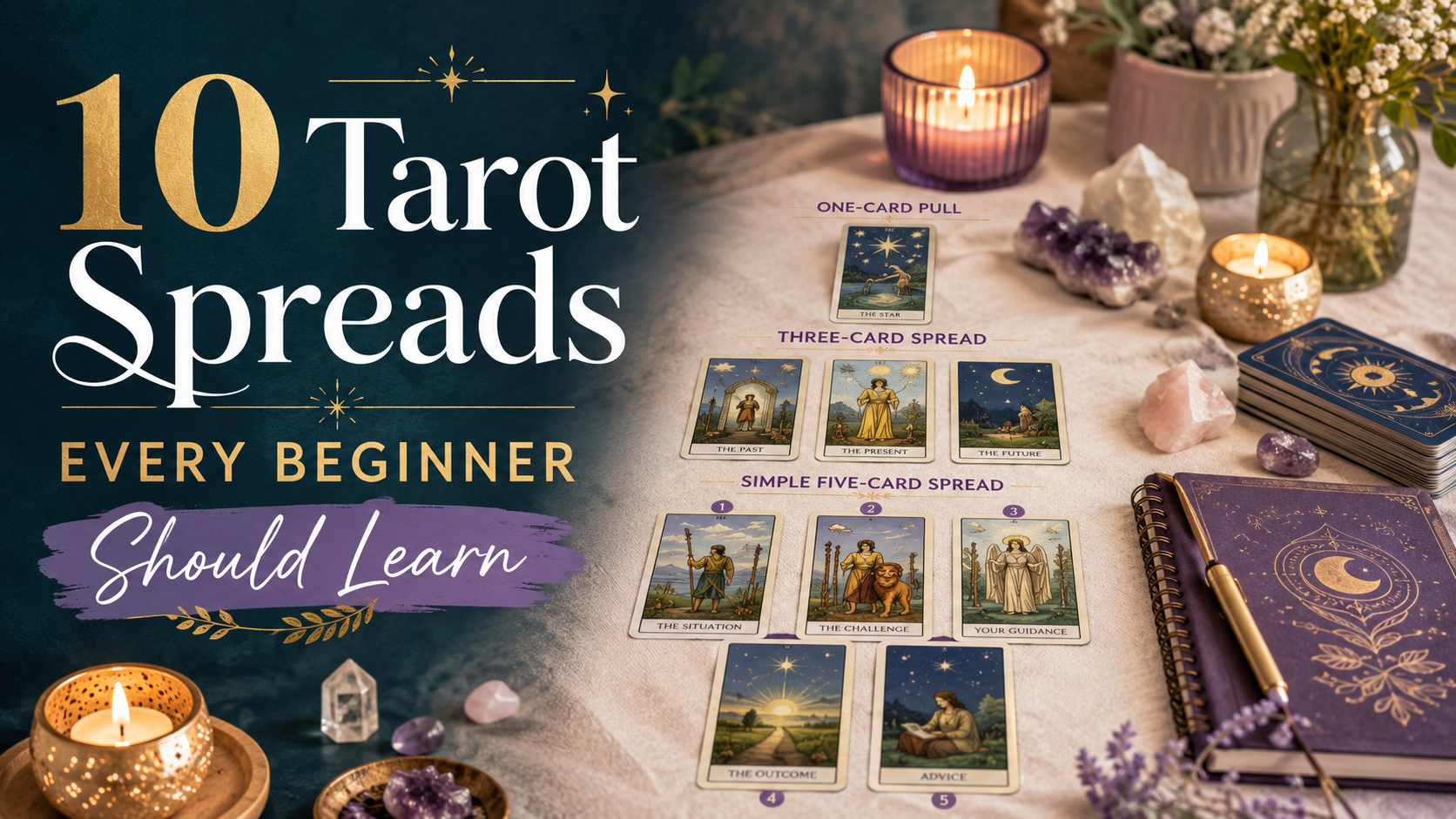
In this guide, you will learn 10 tarot spreads every beginner should learn. Each spread includes card positions, questions to ask, reading tips, and a practical example. These easy tarot spreads help you build confidence, strengthen your intuition, and learn how to read tarot cards with greater clarity.
What Is a Tarot Spread?
A tarot spread is a layout with a set position for each card.
Each position answers one part of your question. For example, a three-card spread might explore the past, present, and future. Another spread might look at your situation, your challenge, and your advice.
Without a spread, you might pull several cards and struggle to understand how they relate. A spread gives the reading a clear path.
Think of each card position as a sentence prompt. The card fills in the meaning.
If the position asks, “What is blocking me?” and you pull the Eight of Swords, the reading might point toward fear, overthinking, or self-doubt. If the same card appears in an advice position, the message shifts. The advice might urge you to question your assumptions and stop treating fear as fact.
The card stays the same. The position changes the role.
How to Prepare for a Tarot Spread
Before you lay out the cards, slow down.
Take one or two steady breaths. Place your feet on the floor. Hold the deck in your hands. Focus on one question.
Try to avoid questions filled with several topics. “Will I get the job, move soon, meet someone, and feel happier?” creates too much noise.
Choose one subject.
Ask:
“What energy surrounds this job opportunity?”
“What do I need to understand about this relationship?”
“What step supports my growth right now?”
“What is influencing my decision?”
Clear questions lead to clearer readings.
Shuffle in the way which feels comfortable. Some readers shuffle until a card falls out. Others stop when they sense the deck feels ready. Some cut the deck into three piles and place them back together.
Choose a method which feels natural.
Keep a tarot journal beside you. Write the date, question, spread, cards, first impressions, and final message. Over time, your journal will show patterns in your readings and your interpretation style.
Tarot Spread 1: The One-Card Daily Guidance Spread
Number of cards: 1
Best for: Daily insight, simple advice, emotional check-ins, and beginner practice.
Question:
“What do I need to know today?”
The Layout
Card 1: Your message for the day.
Why Beginners Should Learn It
The one-card spread teaches focus.
Beginners often pull extra cards because the first card feels unclear. Then the second card raises a new question. The third card adds another layer. Soon, the reading feels crowded.
A one-card reading asks you to stay with one image.
Study the card before opening a guidebook. Notice the colors, faces, body language, symbols, weather, background, and movement. Ask yourself what feeling rises first.
For example, you pull the Four of Swords.
You might notice stillness, rest, silence, and recovery. Your daily message might ask you to pause before reacting. It might suggest rest after a busy period. It might remind you to create quiet space before making a choice.
Beginner Tip
Do not treat the card as a prediction for every event in your day.
Treat it as a theme.
At night, return to the card. Ask how its energy appeared. This habit builds trust in your observations.
Tarot Spread 2: The Past, Present, Future Spread
Number of cards: 3
Best for: Understanding a developing situation, relationship patterns, personal growth, and short-term direction.
The Layout
Card 1: The past influence.
Card 2: The present energy.
Card 3: The future direction.
Why Beginners Should Learn It
This classic spread shows movement.
The first card explains what shaped the situation. The second card shows what you face now. The third card points toward the direction of the current energy.
The future card does not lock you into one outcome. Your choices still matter. Read the final card as the likely direction if the current pattern continues.
Example
Imagine you ask:
“What do I need to understand about my career path?”
You pull:
Past: Eight of Pentacles
Present: Two of Swords
Future: The Chariot
The Eight of Pentacles shows skill-building, effort, and dedication. You spent time developing your abilities.
The Two of Swords shows indecision in the present. You might feel torn between two paths or avoid a choice.
The Chariot shows forward movement through focus and self-direction. Once you choose your path, progress grows faster.
The full message becomes clear. Your past work prepared you. Your present challenge involves a decision. Your future improves when you take control and move with purpose.
Beginner Tip
Look for a story across the three cards.
Ask:
What changed?
What stayed the same?
Did the energy become lighter or heavier?
Did the cards move from confusion toward action?
The connection between the cards matters as much as each separate meaning.
Tarot Spread 3: The Situation, Challenge, Advice Spread
Number of cards: 3
Best for: Problems, decisions, conflict, work concerns, and relationship questions.
The Layout
Card 1: The situation.
Card 2: The challenge.
Card 3: The advice.
Why Beginners Should Learn It
This spread gives you practical guidance.
It does more than describe what is happening. It shows what stands in your way and what response supports you.
Example
You ask:
“How should I handle tension with a friend?”
You pull:
Situation: Five of Wands
Challenge: Queen of Swords Reversed
Advice: Temperance
The Five of Wands points toward tension, clashing opinions, or competing needs.
The Queen of Swords Reversed warns against harsh words, defensiveness, or assumptions.
Temperance asks for patience, balance, and a calm conversation.
The reading does not tell you to ignore the problem. It asks you to lower the emotional heat and speak with care.
Beginner Tip
Pay close attention to the advice card.
Beginners sometimes spend most of the reading analyzing the problem. The advice card holds the part you control. Turn its meaning into one action.
For Temperance, your action might be:
Wait until you feel calm.
Write down your main point.
Listen before responding.
Avoid bringing up old arguments.
A useful tarot reading leads toward a thoughtful response.
Tarot Spread 4: The Mind, Body, Spirit Spread
Number of cards: 3
Best for: Self-care, emotional balance, personal check-ins, and spiritual growth.
The Layout
Card 1: Your mind.
Card 2: Your body.
Card 3: Your spirit.
Why Beginners Should Learn It
This spread helps you see where your energy needs attention.
Your thoughts, physical state, and inner life often influence one another. A stressful thought pattern might affect your sleep. Physical exhaustion might lower your patience. A lack of spiritual connection might leave you feeling disconnected from your purpose.
Example
You pull:
Mind: Nine of Swords
Body: Four of Pentacles
Spirit: The Star
The Nine of Swords shows worry, mental strain, or restless thoughts.
The Four of Pentacles in the body position might suggest tension, holding, or a need for safety. You might clench your jaw, tighten your shoulders, or resist rest.
The Star in the spirit position points toward hope, renewal, and healing. Your inner self seeks peace and gentle restoration.
The reading invites you to calm your mind, release physical tension, and reconnect with something soothing.
Beginner Tip
Avoid using tarot to diagnose health concerns.
Use this spread for reflection. Speak with a qualified health professional about symptoms or medical questions.
Turn the reading into a simple care plan. You might journal for ten minutes, stretch your shoulders, drink water, take a quiet walk, or spend time in prayer or meditation.
Tarot Spread 5: The Decision-Making Spread
Number of cards: 5
Best for: Comparing two choices and understanding the energy around each path.
The Layout
Card 1: The heart of the decision.
Card 2: What supports option A.
Card 3: What challenges option A.
Card 4: What supports option B.
Card 5: What challenges option B.
Why Beginners Should Learn It
Decision readings often become confusing when you ask, “Which option is better?”
A better spread explores each path.
Tarot works well when it reveals energy, benefits, risks, fears, and hidden factors. You still choose. The cards help you see each option more clearly.
Example
You need to choose between staying in your current job or accepting a new role.
Card 1, heart of the decision: Two of Pentacles
Option A support: King of Pentacles
Option A challenge: Four of Cups
Option B support: Ace of Wands
Option B challenge: The Moon
The Two of Pentacles shows a need to balance security and change.
The King of Pentacles supports the current job through stability, income, or experience.
The Four of Cups shows boredom or emotional disengagement.
The Ace of Wands supports the new role through excitement and growth.
The Moon warns about unclear details, uncertainty, or missing information.
The reading shows a clear tradeoff. The current job offers stability but lacks inspiration. The new role offers energy but needs more research.
Beginner Tip
Ask follow-up questions outside the deck.
Review the salary, schedule, commute, contract, benefits, expectations, and growth path. Tarot reveals emotional and energetic factors. Facts complete the decision.
If you keep pulling cards because anxiety makes every answer feel uncertain, pause. A private psychic reading gives you space to discuss the full situation and receive focused guidance. Book a reading with me when you want support with love, career, life changes, or a decision which feels hard to sort through alone.
Tarot Spread 6: The Relationship Energy Spread
Number of cards: 5
Best for: Romantic relationships, friendships, family relationships, and work partnerships.
The Layout
Card 1: Your energy.
Card 2: Their energy.
Card 3: The connection.
Card 4: The challenge.
Card 5: The guidance.
Why Beginners Should Learn It
This spread keeps the reading balanced.
Relationship readings often focus only on the other person. “What do they feel?” “What will they do?” “Will they contact me?”
Those questions matter, yet your energy matters too.
This spread shows both sides, the bond, the challenge, and the healthiest guidance available.
Example
You ask about a new romantic connection.
Your energy: Queen of Cups
Their energy: Knight of Pentacles
The connection: Two of Cups
The challenge: Seven of Pentacles
The guidance: Page of Swords
The Queen of Cups shows emotional openness and sensitivity.
The Knight of Pentacles shows a slower, practical approach.
The Two of Cups shows mutual interest and emotional connection.
The Seven of Pentacles shows impatience or a need to let the bond develop over time.
The Page of Swords asks for honest questions, clear communication, and careful observation.
The message suggests real potential, different pacing, and a need for open communication.
Beginner Tip
Do not use one spread to invade someone’s privacy or feed obsession.
Focus on the connection, your experience, and your choices.
Useful questions include:
“What do I need to understand about this connection?”
“What pattern influences us?”
“What boundary supports me?”
“What is the healthiest next step?”
These questions keep the reading grounded.
Tarot Spread 7: The Love Potential Spread
Number of cards: 6
Best for: New connections, dating, relationship growth, and emotional compatibility.
The Layout
Card 1: The current energy between you.
Card 2: What draws you together.
Card 3: What creates distance.
Card 4: What needs honest discussion.
Card 5: The growth potential.
Card 6: Your guidance.
Why Beginners Should Learn It
This spread explores love without reducing the reading to a yes or no answer.
Attraction does not always equal compatibility. Strong feelings do not always create a stable relationship. A connection might hold potential while still needing boundaries, timing, or communication.
Example
Current energy: The Lovers
What draws you together: Six of Cups
What creates distance: Eight of Swords
What needs discussion: Justice
Growth potential: Ten of Pentacles
Guidance: Queen of Wands
The Lovers shows attraction and a meaningful choice.
The Six of Cups shows comfort, familiarity, or a warm emotional bond.
The Eight of Swords shows fear, hesitation, or overthinking.
Justice asks for honesty, fairness, and clear expectations.
The Ten of Pentacles shows potential for long-term stability.
The Queen of Wands asks you to stay confident and maintain your identity.
The spread shows strong potential, yet fear and unclear expectations need attention. The guidance asks you to stay warm, direct, and self-respecting.
Beginner Tip
Read potential as potential.
Do not treat it as a promise.
Watch how people act. Notice whether words and behavior match. Use tarot as one source of insight, not as a replacement for communication or boundaries.
Tarot Spread 8: The Blockage and Breakthrough Spread
Number of cards: 5
Best for: Feeling stuck, repeating patterns, creative blocks, emotional healing, and personal growth.
The Layout
Card 1: Where you feel stuck.
Card 2: The root of the blockage.
Card 3: What keeps the blockage active.
Card 4: What helps you move forward.
Card 5: The energy after the shift.
Why Beginners Should Learn It
This spread goes beneath the surface.
A problem often continues because the visible issue is not the root issue. You might think you lack motivation, while fear of failure drives the delay. You might think a relationship needs more effort, while weak boundaries keep the conflict active.
Example
You ask:
“Why do I keep delaying my creative project?”
Where you feel stuck: Eight of Pentacles Reversed
Root of the blockage: Five of Pentacles
What keeps it active: The Devil
What helps: Strength
Energy after the shift: Three of Wands
The Eight of Pentacles Reversed shows inconsistent effort or frustration with your progress.
The Five of Pentacles points toward fear of failure, rejection, or lack.
The Devil shows an unhealthy cycle. Perfectionism, comparison, or self-criticism might keep you trapped.
Strength asks for patience, courage, and a kinder approach.
The Three of Wands shows expansion and forward movement after you change the pattern.
The reading suggests your delay comes from fear, not laziness. A steady routine and self-respect help you move.
Beginner Tip
Ask yourself one honest question after the reading:
“What action matches the guidance card?”
Strength might lead you to work for twenty minutes without judging the result. The action should feel small enough to start today.
Tarot Spread 9: The Goal-Setting Spread
Number of cards: 6
Best for: Career goals, business plans, creative projects, spiritual goals, and personal development.
The Layout
Card 1: Your goal.
Card 2: Your current strength.
Card 3: The main obstacle.
Card 4: What you need to learn.
Card 5: Your next step.
Card 6: The likely direction with steady effort.
Why Beginners Should Learn It
Tarot does not only explore emotions and relationships. It also supports planning.
A goal spread helps you identify your resources, challenges, lessons, and next action. It turns a broad dream into a focused path.
Example
You ask:
“What should I focus on while growing my business?”
Your goal: The Empress
Current strength: Queen of Wands
Main obstacle: Seven of Cups
What you need to learn: The Emperor
Next step: Eight of Pentacles
Likely direction: Six of Wands
The Empress shows growth, creativity, and a desire to build something abundant.
The Queen of Wands shows confidence, visibility, and personal magnetism.
The Seven of Cups warns against too many ideas or scattered focus.
The Emperor asks for structure, systems, boundaries, and planning.
The Eight of Pentacles asks you to strengthen your craft through consistent work.
The Six of Wands points toward recognition and progress.
The message asks you to choose fewer priorities, create a schedule, improve your skills, and show your work.
Beginner Tip
Turn the spread into a written plan.
For example:
Choose one main goal for the month.
Set three weekly tasks.
Track your progress.
Review what works.
Remove tasks which waste time.
Tarot becomes more useful when you pair insight with action.
Tarot Spread 10: The Celtic Cross Spread
Number of cards: 10
Best for: A detailed overview of a major situation.
The Layout
Card 1: The present situation.
Card 2: The crossing influence or challenge.
Card 3: The conscious focus.
Card 4: The deeper root.
Card 5: The recent past.
Card 6: The near future.
Card 7: Your attitude or position.
Card 8: Outside influences.
Card 9: Hopes and fears.
Card 10: The likely outcome.
Why Beginners Should Learn It
The Celtic Cross gives a full picture.
It explores the present, the challenge, the past, the future, your inner state, outside influences, and the likely direction.
This spread looks intimidating at first. Learn it after you feel comfortable with one-card, three-card, and five-card spreads.
Do not rush through all ten cards.
Read them in groups.
Start with cards 1 and 2. What is happening, and what crosses it?
Then read cards 3 and 4. What do you think about the situation, and what sits underneath it?
Read cards 5 and 6 as movement from the recent past into the near future.
Read cards 7 through 10 as your position, the environment, your hopes and fears, and the outcome.
Example
Suppose you ask about a major life transition.
Present: Death
Challenge: Four of Pentacles
Conscious focus: The Fool
Deeper root: Ten of Wands
Recent past: The Tower
Near future: Six of Swords
Your attitude: Queen of Swords
Outside influence: Three of Pentacles
Hopes and fears: The Star
Outcome: The World
Death shows a major ending and transformation.
The Four of Pentacles shows resistance to release.
The Fool shows your desire for a fresh start.
The Ten of Wands shows exhaustion at the root of the situation.
The Tower shows a recent disruption.
The Six of Swords points toward transition and calmer energy.
The Queen of Swords shows a need for clear judgment and firm boundaries.
The Three of Pentacles shows support, teamwork, or professional help.
The Star shows hope mixed with fear of disappointment.
The World points toward completion, closure, and a new chapter.
The spread tells one connected story. A major ending follows a difficult period. Resistance makes the transition harder. Clear thinking, support, and willingness to move forward lead toward closure.
Beginner Tip
Write one sentence for each card. Then combine the sentences into one paragraph.
This method stops you from getting lost in separate meanings.
How to Read Reversed Cards in Beginner Tarot Spreads
Reversed cards often worry new readers.
A reversed card does not always mean something bad.
It might show:
Blocked energy.
Internal energy.
A delay.
An imbalance.
An extreme form of the upright meaning.
A lesson still in progress.
For example, the Chariot upright often shows movement, direction, and control. Reversed, it might show scattered focus, delays, or a lack of direction.
The Queen of Cups upright often shows compassion and emotional awareness. Reversed, she might show emotional overwhelm, weak boundaries, or neglected needs.
Choose one reversal method and use it consistently for a while. This approach helps you learn.
You also have the option to read every card upright while you build confidence. Plenty of skilled readers use upright cards only.
How to Connect Cards in a Tarot Spread
A tarot reading grows stronger when you connect the cards.
Look for repeated suits.
Several Cups point toward emotions, relationships, intuition, or healing.
Several Swords point toward thoughts, communication, truth, stress, or conflict.
Several Wands point toward action, passion, creativity, or ambition.
Several Pentacles point toward work, money, health routines, security, or practical matters.
Look for repeated numbers.
Several Twos might point toward choices, balance, or partnership.
Several Fives might show conflict, change, or instability.
Several Tens might show completion, endings, or the final stage of a cycle.
Notice Major Arcana cards.
A spread with several Major Arcana cards often points toward an important life lesson, deep transition, or meaningful turning point.
Notice direction.
Do the figures face one another or turn away?
Does one card show movement toward another card?
Does the energy grow calmer across the spread?
Does the reading move from fear toward confidence?
Visual details often reveal the story before keywords do.
Common Tarot Spread Mistakes Beginners Make
Pulling Too Many Clarifying Cards
One clarifying card might help. Six clarifying cards often create confusion.
Before pulling another card, ask:
“What part feels unclear?”
Then pull one card for the specific point.
Asking the Same Question Repeatedly
Repeated readings often reflect anxiety more than intuition.
Give the situation time to develop. Return to the cards after new information appears or after your actions shift the energy.
Ignoring the Spread Position
A card meaning changes through its position.
The Tower in a challenge position differs from the Tower in an advice position. In a challenge position, it might show instability. In an advice position, it might ask you to face the truth and stop protecting a weak structure.
Reading Every Card as a Prediction
Tarot also shows emotions, patterns, beliefs, choices, fears, and advice.
Not every card predicts an event.
Using Fear-Based Interpretations
Cards such as Death, The Devil, The Tower, and Ten of Swords often scare beginners.
Slow down.
Death often points toward endings and transformation.
The Devil often points toward attachment, temptation, fear, or unhealthy patterns.
The Tower often points toward sudden truth or necessary change.
The Ten of Swords often marks a painful ending which has reached its final point.
Read the card in context. Look at the question, position, surrounding cards, and your first impression.
How to Build Confidence With Tarot Spreads
Practice with low-pressure questions.
Ask about your energy for the day, a lesson from the week, or the best focus for a personal goal. Avoid starting with emotionally intense questions every time you open the deck.
Use the same spread for a few weeks.
Repetition helps you understand each position. You begin to notice how different cards behave in the same role.
Say the reading out loud.
Speaking forces you to connect the cards into a clear message. Pretend you are explaining the spread to a friend.
Keep your language simple.
You do not need dramatic spiritual language. Say what you see.
“The cards show hesitation around this choice.”
“This relationship needs clearer communication.”
“You have strong creative energy, yet scattered focus slows your progress.”
“The advice asks you to rest before making the next move.”
Simple language often brings the clearest reading.
Trust your first response, then check the guidebook.
Your first feeling might come from the image, a memory, a body sensation, or a phrase which enters your mind. Write it down before reading a traditional meaning.
Over time, you will learn where intuition ends and wishful thinking begins. A journal helps with this process.
Which Tarot Spread Should a Beginner Start With?
Start with the one-card daily guidance spread.
Then move to:
Past, present, future.
Situation, challenge, advice.
Mind, body, spirit.
After those feel comfortable, practice the five-card spreads.
Save the Celtic Cross for later. It becomes easier once you know how to connect smaller groups of cards.
You do not need to master all ten spreads at once.
Choose one spread. Use it several times. Review your notes. Learn how each position changes the card meaning.
Tarot skill grows through steady practice, honest reflection, and patience.
My Final Thoughts on Tarot Spreads for Beginners
Tarot spreads give your readings structure.
They help you move from random card pulls toward focused guidance. Each position gives the card a purpose. Each card adds one part of the story.
The best beginner tarot spreads are not the most complicated ones. They are the spreads which help you ask better questions, understand patterns, and take thoughtful action.
Start with one card.
Move into three cards.
Practice five-card layouts.
Learn the Celtic Cross when you feel ready for a fuller reading.
Keep a journal. Review your readings. Pay attention to patterns. Let your relationship with the cards grow through experience.
Your intuition does not need to shout. It often speaks through a quiet feeling, a repeated symbol, a clear sentence, or a card which keeps drawing your attention.
When you need guidance on a personal situation, book a private psychic reading with me. I will help you explore the energy around love, relationships, career, life changes, and the questions weighing on your heart. A personal reading gives you focused insight, clear support, and space to understand what your intuition has been trying to show you.
Book your psychic reading today and receive guidance shaped around your situation, your energy, and your next step.
