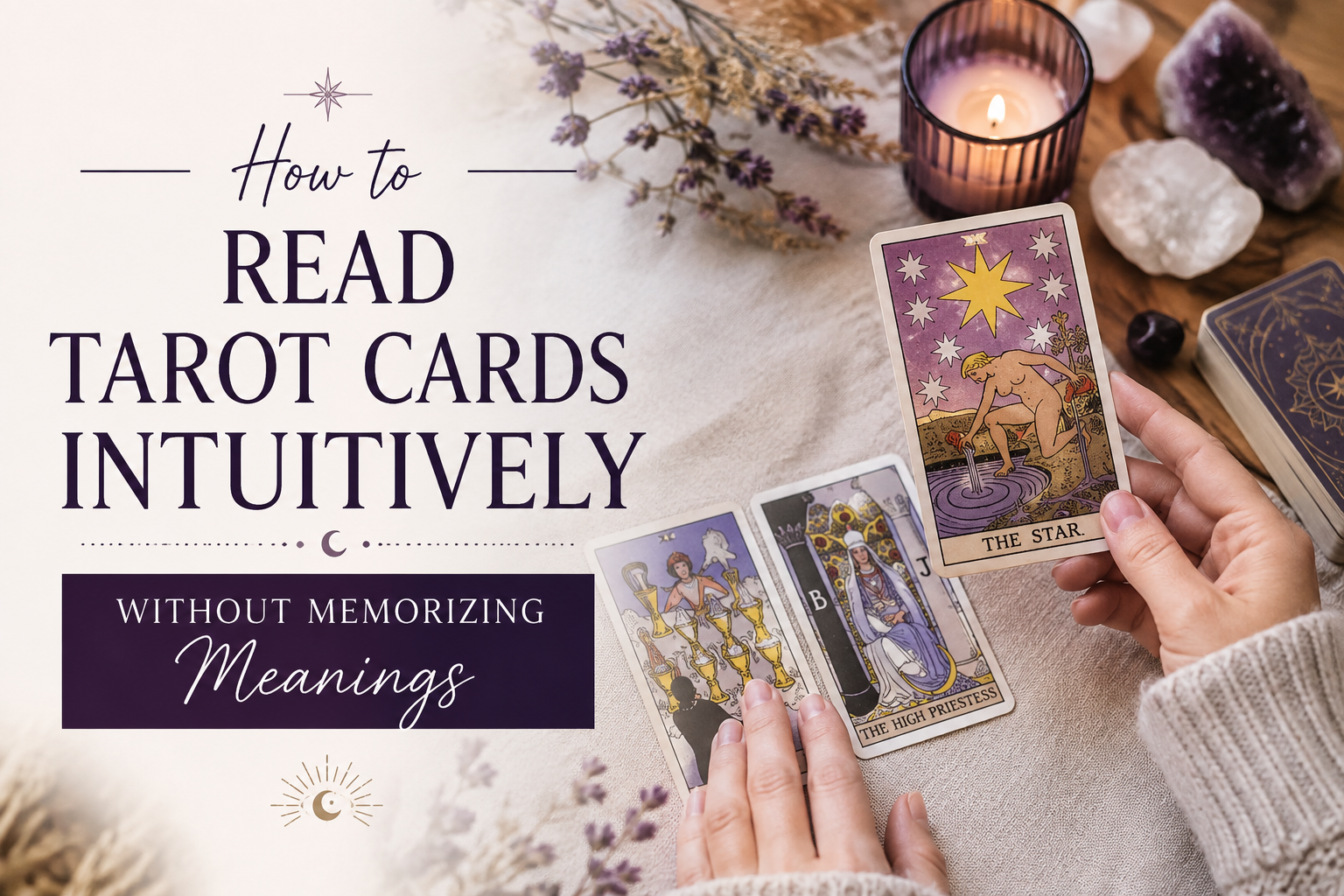
You shuffle your tarot deck, pull three cards, and stare at the images.
Your mind goes blank.
One card feels hopeful. Another looks confusing. The final card seems completely unrelated to the question. Instead of trusting your first response, you reach for the guidebook. Then you search online. Soon, five different interpretations compete for your attention.
The reading starts feeling like a test you forgot to study for.
Tarot should never make you feel pressured to perform. You do not need to memorize seventy-eight perfect definitions before giving a meaningful reading. Your intuition already responds to the artwork, symbols, expressions, colors, and energy within each card.
The strongest message often arrives before your logical mind starts analyzing everything.
Perhaps your eyes keep returning to one figure in the spread. A certain symbol might remind you of the person asking the question. One card could create a physical feeling in your chest or stomach. Those responses matter.
Intuitive tarot reading begins when you stop asking, “What am I supposed to say?” and start asking, “What am I noticing right now?”
Need personal clarity about a relationship, career decision, or confusing situation? Book a psychic tarot reading with me. I will help you understand the energy surrounding your question and identify the message your intuition already senses.
Learning how to read tarot cards intuitively without memorizing meanings helps you create readings filled with clarity, emotional depth, and personal insight. Traditional tarot meanings offer a useful foundation, yet memorization alone often produces stiff readings. Intuition helps you connect the cards to the exact person, question, and situation in front of you.
Every tarot card contains layers of meaning. The same card might represent confidence in one reading, control in another, and emotional distance somewhere else. Context changes the message.
Your goal does not involve reciting definitions word for word. Instead, you learn how to notice which symbols stand out, recognize your emotional response, connect the images, and form a clear story.
This guide will show you how to trust your first impressions, read tarot symbols, understand the energy of a spread, work with traditional meanings, and interpret cards without forcing a message.
Most importantly, you will learn one truth every tarot reader needs to hear.
You do not have to interpret every card in every spread.
Sometimes only one, two, or three cards stand out because they carry the central message. Other cards might support the reading quietly. Forcing yourself to explain every single card often weakens the message instead of strengthening it.
What Does It Mean to Read Tarot Cards Intuitively?
Intuitive tarot reading involves receiving information through your natural inner awareness while looking at the cards.
You notice an image.
A feeling follows.
Next, a thought, memory, word, or impression enters your mind.
Rather than dismissing the response, you explore how it connects to the question.
Suppose you pull the Six of Swords during a relationship reading. Traditional meanings include transition, moving forward, leaving difficulties behind, or traveling. During one reading, your attention might go directly toward the people sitting silently in the boat.
Their silence might feel more important than the movement.
From there, you might sense emotional distance, unspoken pain, or a couple avoiding a difficult conversation. The card still relates to transition, yet intuition reveals which part of the traditional meaning fits the situation.
Another reader might focus on the water. One side looks rough while the other appears calm. Their interpretation might center on emotional relief after conflict.
Neither interpretation automatically becomes wrong. Each reader notices a different doorway into the card.
Intuitive reading does not mean inventing random stories. Strong intuitive messages connect with the imagery, the question, the surrounding cards, and the emotional tone of the spread.
Why Memorizing Every Tarot Meaning Feels Overwhelming
A standard tarot deck includes seventy-eight cards. Each card has upright meanings, reversed meanings, love meanings, career meanings, spiritual meanings, and emotional meanings.
Trying to memorize every possible interpretation creates pressure.
Fear often replaces curiosity.
Instead of studying the card in front of you, your mind searches through a mental list. You might remember one keyword while forgetting several others. Confidence drops because you feel responsible for finding the “correct” answer.
Tarot rarely works through one rigid definition.
Consider the Four of Pentacles. Traditional keywords include holding on, control, security, possessiveness, protection, and fear of loss.
During a financial reading, the card might warn someone against spending money.
Inside a love reading, the same card might show emotional walls.
Within a career spread, it might reflect someone staying in an unfulfilling job because security feels safer than change.
The traditional meaning provides a foundation. Intuition selects the relevant layer.
Memorization still serves a purpose. Learning the basic structure of tarot gives you a shared language for the cards. Problems begin when you treat definitions as strict rules.
A guidebook should support your insight rather than replace it.
Your First Impression Matters
Look at any tarot card for five seconds.
What catches your eye first?
Perhaps you notice a facial expression. Maybe a bright color grabs your attention. Your focus might land on a small object in the background. A word could enter your mind before you understand why.
Write down the first response.
Avoid correcting yourself.
First impressions often arrive quickly because intuition communicates before analysis takes control. Once the logical mind steps forward, you might start doubting, editing, or searching for a more impressive answer.
Simple impressions often carry the strongest truth.
A woman looking away might make you think, “She does not want to face him.”
A closed door might create the thought, “This opportunity has ended.”
A rising sun could bring the feeling, “Relief arrives soon.”
Those messages sound straightforward because intuition rarely needs complicated language.
Try describing what you see before interpreting anything.
You might say, “The figure looks guarded. His arms cover his chest. The background feels empty. No one stands near him.”
From this description, an interpretation forms naturally.
The card might represent emotional protection, loneliness, defensiveness, or refusing help.
Literal observation leads you toward intuitive meaning.
Use the Artwork as Your Starting Point
Every tarot deck speaks through its artwork.
Colors create emotional tone. Body language reveals hidden motives. Weather reflects tension or peace. Animals, plants, buildings, and objects add another layer.
Begin by studying five areas.
First, notice the people.
Look at their expressions, posture, direction, clothing, and interaction. Ask yourself whether they appear open, guarded, confident, afraid, focused, or disconnected.
Second, examine the environment.
A bright landscape often creates a different message from a dark forest. Mountains might suggest challenges or long-term goals. Water often connects with emotions. Roads frequently represent choices or movement.
Third, observe the colors.
Red might bring passion, anger, urgency, or courage. Blue often connects with calmness, truth, communication, or sadness. Yellow might suggest awareness, optimism, attention, or exposure.
Your personal response matters more than a fixed color chart.
Fourth, study the objects.
Swords, cups, flowers, keys, ropes, crowns, walls, and windows all add meaning. Notice which object feels important during the reading.
Fifth, pay attention to movement.
Is the figure walking forward, looking backward, standing still, falling, reaching, hiding, or waiting? Movement often reveals where the situation is heading.
You Do Not Need to Read Every Card in Every Spread
New tarot readers often believe every card deserves a full explanation.
This belief creates forced readings.
Imagine pulling ten cards for one question. Two cards immediately grab your attention. They seem connected, while the remaining cards feel quiet or secondary.
Trust the cards pulling your focus.
Those two cards might hold the core message.
The others might create background energy, confirm the theme, describe minor details, or offer context for later. You do not need to force a separate interpretation for every card.
Sometimes one card speaks so loudly it becomes the entire reading.
A spread might contain the Lovers, the Seven of Swords, the Page of Cups, the Three of Pentacles, and the Hermit. Your eyes keep returning to the Seven of Swords and the Hermit.
Together, those cards might show avoidance, secrecy, withdrawal, or someone hiding their true intentions. The remaining cards still matter, yet the central message comes through the cards demanding attention.
Trying to create equal speaking time for all five cards might confuse the reading.
Tarot does not require equal interpretation.
Think about a conversation in a room full of people. Several voices might speak, yet one statement changes the entire discussion. Tarot spreads often work the same way.
A few cards deliver the headline.
Other cards provide supporting information.
Some cards remain quiet because their meaning has already appeared elsewhere.
Reading every card also risks repetition. Three different cards might express the same emotional pattern. Instead of explaining each card separately, combine them into one clear message.
For example, the Eight of Cups, Six of Swords, and Death might all point toward leaving a difficult chapter. Rather than giving three separate definitions, you might say:
“This spread strongly emphasizes emotional departure, transition, and the end of an old cycle. The person appears ready to move forward even though part of them still feels attached.”
One connected message feels stronger than three disconnected explanations.
Give yourself permission to leave a card alone when no clear message arrives.
A quiet card does not mean you failed.
Your intuition might return to it later. Another card might activate its meaning. The message might become clearer after the reading develops.
Never force an interpretation to prove your ability.
How to Know Which Cards Carry the Main Message
Certain cards naturally pull your attention.
One might feel brighter than the others.
Another might create an emotional reaction.
A repeated symbol could appear across several cards.
Major Arcana cards often carry strong themes because they represent major lessons, turning points, or life chapters. Court cards might identify a person, personality, or behavior. Repeated numbers might reveal timing, patterns, or stages.
Notice the following signals:
Your eyes keep returning to one card.
A card creates a strong physical sensation.
You hear a word or phrase in your mind.
The artwork reminds you of someone involved.
Several cards repeat the same symbol or direction.
One card appears to answer the question directly.
A card feels emotionally louder than the rest.
The card at the center, beginning, or end of the spread feels important.
Use those signals as clues rather than strict rules.
For instance, a Major Arcana card does not always overpower every Minor Arcana card. A simple Two of Swords might hold the key message when the question concerns a decision.
Follow the energy of the reading.
A Step-by-Step Method for Intuitive Tarot Reading
Step 1: Ask a Clear Question
Vague questions often create vague readings.
Instead of asking, “What will happen?” ask, “What energy surrounds my relationship over the next three months?”
Replace “Does this person like me?” with “What emotional intentions does this person currently hold toward me?”
Clear questions give your intuition a useful direction.
Open-ended questions often create deeper insight than questions requiring a simple yes or no.
Try questions such as:
“What do I need to understand about this situation?”
“What blocks progress between us?”
“What energy am I bringing into this connection?”
“What step supports my highest well-being?”
“What truth am I avoiding?”
Step 2: Ground Yourself Before Shuffling
Take several slow breaths.
Place both feet on the floor.
Relax your shoulders.
Focus on the question.
You do not need an elaborate ritual. A calm moment helps reduce mental noise.
Some readers hold the deck near their chest. Others place a hand over the cards. Choose a method which helps you feel present.
Step 3: Pull Fewer Cards
Large spreads often overwhelm beginners.
Start with one card.
After gaining confidence, move toward three cards.
A three-card spread might represent:
Past, present, future.
Situation, challenge, guidance.
You, the other person, the connection.
What you know, what you do not know, what you need to understand.
Fewer cards create space for deeper observation.
Step 4: Look Before Recalling Meanings
Spend time studying each image before thinking about keywords.
Ask:
Where did my eyes go first?
How does this card feel?
What seems to be happening?
What might happen next?
Which person holds the power?
What remains hidden?
What story does the image suggest?
Your answers begin the reading.
Step 5: Notice Your Body
Intuition often speaks through physical sensations.
Tightness in your chest might signal emotional pressure.
A heavy stomach might reflect fear or dishonesty.
Warmth around your heart might suggest affection or relief.
Sudden tension might point toward conflict.
Physical responses do not always predict outside events. Sometimes they reflect your own emotional state. Ask whether the sensation feels personal or connected to the reading.
Practice helps you learn the difference.
Step 6: Say the First Message Out Loud
Speaking helps intuitive information flow.
Begin with simple language.
“This person looks exhausted.”
“The energy feels delayed.”
“She appears ready to leave.”
“I keep noticing the locked gate.”
“This card feels more hopeful than the others.”
Avoid judging your statement before finishing it.
Once you speak the first message, another thought often follows.
Step 7: Connect the Cards
Stop treating each card like an isolated definition.
Look for a story.
Where do the figures face?
Does one card move toward another?
Do the colors grow brighter or darker?
Does the emotional energy improve or decline?
Imagine pulling the Five of Cups, Strength, and the Star.
Instead of saying:
“Five of Cups means grief. Strength means courage. The Star means hope.”
Create a connected message:
“You appear to be moving through disappointment, yet emotional strength grows through the experience. Healing follows once you stop judging yourself for what happened.”
The story creates meaning.
Step 8: Let the Main Cards Lead
Choose the cards carrying the strongest energy.
Build the reading around them.
Supporting cards should clarify the central theme rather than compete with it.
Suppose the Tower appears beside the Four of Pentacles and Two of Wands. The Tower might dominate the spread because it shows an unavoidable disruption. The Four of Pentacles suggests resistance, while the Two of Wands points toward planning a new direction.
Your message might become:
“A sudden change breaks through a situation you have tried to control. Holding on creates more stress. The next step involves choosing a new direction instead of rebuilding the same pattern.”
Step 9: Check Traditional Meanings Afterward
Once you finish your intuitive interpretation, review the guidebook.
Notice where your message matches the traditional meaning.
Explore any new layer the guidebook adds.
This process trains your mind without silencing intuition.
Over time, traditional meanings become familiar through experience rather than forced memorization.
Step 10: Record the Reading
Keep a tarot journal.
Write the date, question, cards, first impressions, traditional meanings, and final message.
Return later to see what unfolded.
Accuracy grows through reflection.
Your journal also reveals how certain cards speak personally to you.
For example, the Knight of Wands might repeatedly represent someone entering quickly and leaving soon. The Queen of Swords might appear whenever firm boundaries become necessary.
Personal associations form your intuitive tarot language.
Ready for deeper insight into a confusing relationship or emotional situation? Book a psychic tarot reading with me. Together, we will explore the strongest energy in your spread without forcing every card into the message.
Practice Exercise 1: Describe the Card Without Interpreting It
Choose one card.
Set a timer for three minutes.
Write only what you see.
Include the person, expression, colors, objects, weather, surroundings, and movement.
Avoid traditional keywords.
After three minutes, read your description.
Circle any details carrying emotion.
Turn those details into a message.
Suppose you describe the Nine of Wands:
“A tired person holds one wand. Eight wands form a wall behind him. His head has a bandage. He looks alert even though he seems exhausted.”
An intuitive message might become:
“You have endured repeated stress. Part of you expects another problem, so you remain guarded. Rest and stronger boundaries matter before moving forward.”
The meaning grew from observation.
Practice Exercise 2: Create a Story Between Two Cards
Pull two cards.
Place them side by side.
Imagine the figures share one scene.
Ask:
What happened before this moment?
How does each person feel?
What tension exists between them?
What does one card want from the other?
Which card holds more power?
Where does the story lead?
Suppose you pull the Queen of Cups beside the Eight of Swords.
The Queen might represent emotional wisdom. The Eight of Swords might show fear and restricted thinking.
A possible message:
“Your intuition understands the situation, yet fear keeps questioning what you already feel. Emotional awareness offers the way out.”
Practice Exercise 3: Find the Loudest Card
Pull five cards.
Look at the spread for ten seconds.
Turn away.
Which card do you remember first?
Return to the spread and ask why the card stayed in your mind.
Study its colors, symbols, and emotional tone.
Build the reading around the remembered card.
Next, choose one or two supporting cards.
Leave the others alone unless they add useful information.
This exercise teaches you how to identify the central message without feeling responsible for interpreting every card.
Practice Exercise 4: Read the Energy Without Naming the Cards
Pull three cards.
Describe the energy without using card names or standard meanings.
For example:
“The first image feels tense and guarded. The second brings a choice. The final image feels lighter and more open. This suggests stress begins to ease after a firm decision.”
Removing card names helps you focus on the message instead of definitions.
Practice Exercise 5: Ask What Changed
Pull one card for the current energy.
Wait a few minutes.
Pull another card while asking, “What needs to change?”
Compare the two images.
Perhaps the first card shows stillness while the second shows movement. The message might involve taking action.
Another pair might move from confusion toward clarity, isolation toward connection, or fear toward confidence.
Contrast often reveals intuitive meaning quickly.
How to Blend Intuition With Traditional Tarot Meanings
Intuition and traditional meanings work well together.
Tradition gives structure.
Intuition provides relevance.
Picture traditional meanings as a collection of possible themes. Your intuitive response identifies which theme belongs in the current reading.
Take the Devil card.
Common meanings include unhealthy attachment, temptation, obsession, control, fear, addiction, and feeling trapped.
During one relationship reading, your attention might focus on the chains. The message could involve dependency.
Elsewhere, you might notice how loose the chains appear. The reading might reveal a person has more freedom than they realize.
Inside a career reading, the Devil could point toward feeling trapped by money or status.
Each interpretation stays connected to the card while responding to the question.
Avoid abandoning traditional meanings completely. Without structure, intuition might become influenced by wishful thinking, anxiety, or personal bias.
Use both systems.
Ask yourself:
Does my impression connect with the card’s established theme?
Does it answer the question?
Do the surrounding cards support it?
Does the message feel clear rather than dramatic?
Am I interpreting the card or projecting my fear?
These questions strengthen accuracy.
Common Mistakes New Intuitive Tarot Readers Make
Forcing a Message
Pressure blocks natural insight.
A card might need time before its meaning becomes clear. Pause, observe, or move to another card.
Return later if needed.
Guessing dramatically often produces confusion. Simple messages usually help more.
Reading Every Card Separately
Separate definitions create scattered readings.
Blend related cards into one theme.
Allow the strongest cards to lead.
Leave quiet cards in the background.
Changing the Message to Make It Positive
Some readings reveal uncomfortable truths.
A relationship might lack emotional availability.
A plan might need more preparation.
A person might avoid responsibility.
Offer compassion without changing the message.
Honesty helps more than false reassurance.
Treating Reversed Cards as Automatically Negative
Reversed cards often show blocked energy, delays, internal experiences, resistance, or imbalance.
Study the image and context.
The reversed Sun might reflect temporary disappointment rather than disaster. A reversed Eight of Swords might show release from fear.
Let the spread guide the interpretation.
Asking the Same Question Repeatedly
Repeated readings often create anxiety.
After receiving a clear message, give the situation time.
Pulling more cards because you dislike the answer usually adds confusion.
Use tarot for guidance rather than emotional reassurance.
Ignoring Your Emotional State
Strong emotions influence interpretation.
Fear might make neutral cards look threatening.
Hope might make warning cards appear harmless.
Pause before reading when you feel overwhelmed.
Ground yourself or ask another trusted reader for perspective.
How to Read Tarot Intuitively for Yourself
Self-readings feel harder because personal hopes and fears enter the interpretation.
Start with grounded questions.
Ask what you need to understand rather than what you want to hear.
Keep the spread small.
Write your first impression before changing it.
Review the reading later.
Avoid pulling clarification cards endlessly.
One useful approach involves reading the cards as though they belong to someone else. Imagine a friend handed you the same spread. What would you tell them?
Distance creates honesty.
Another method involves separating facts, fears, and intuition.
Write three sections in your journal.
Facts include information you know.
Fears include possible outcomes worrying you.
Intuition includes the quiet message arriving without panic.
Fear often feels urgent and repetitive.
Intuition usually feels direct and steady, even when the message feels uncomfortable.
How to Read Tarot Intuitively for Other People
Begin by listening carefully to the question.
Avoid filling gaps with assumptions.
Describe what you see before making firm statements.
Use language focused on energy, choices, behavior, and patterns.
Instead of saying, “He will never contact you again,” say, “The current spread shows withdrawal, avoidance, and limited effort. Contact does not appear to be his priority right now.”
This approach offers clarity without pretending every future choice stays fixed.
Respect privacy.
Do not use tarot to encourage spying, manipulation, or control.
Focus on what the person receiving the reading needs to understand.
Helpful questions include:
“What power do you hold in this situation?”
“What pattern keeps repeating?”
“What boundary would protect your energy?”
“What action supports your emotional well-being?”
“What truth deserves your attention?”
Strong readings leave people informed rather than dependent.
How Long Does It Take to Become an Intuitive Tarot Reader?
Progress depends on consistent practice.
One card each day teaches more than cramming dozens of meanings in one sitting.
Study the image.
Write your impression.
Review the traditional meaning.
Notice what happens during the day.
After several weeks, patterns begin appearing.
Confidence grows when you see your interpretations connect with real events, emotions, and decisions.
Avoid comparing your reading style with someone else’s approach.
One reader might receive clear words.
Another might feel physical sensations.
Someone else might notice symbols and visual stories.
Your strongest intuitive channel develops through use.
Signs Your Intuitive Tarot Reading Is Improving
You trust your first response more often.
Card meanings form through the story rather than isolated keywords.
Your readings become simpler and clearer.
Repeated symbols stand out quickly.
Physical sensations become easier to understand.
You recognize when personal fear affects the message.
Fewer clarification cards feel necessary.
Quiet cards no longer create panic.
You feel comfortable saying, “This card supports the theme, but it does not need a separate interpretation.”
Most importantly, the reading starts feeling like a conversation rather than an exam.
What to Do When Nothing Comes Through
Every reader experiences quiet moments.
Fatigue, stress, distraction, or emotional attachment might block your focus.
Start by describing the card literally.
Ask one simple question.
“What feels most important here?”
Change your physical position.
Take a short break.
Use fewer cards.
Review the question for clarity.
Sometimes the spread feels silent because the question needs improvement.
Other times, the message has already arrived through one card while you keep searching for more.
Respect the silence.
A reading does not need to become long to become valuable.
One honest sentence might carry more meaning than twenty minutes of forced interpretation.
Trust the Cards Which Speak First
Tarot intuition grows through attention.
You do not need perfect memory.
You do not need an impressive vocabulary.
You do not need to explain every detail on every card.
Focus on what stands out.
Notice what you feel.
Describe what you see.
Connect the images.
Let the main cards carry the reading.
Allow supporting cards to remain supportive.
Leave quiet cards alone until they offer something useful.
A spread does not fail because one card stays unclear. Sometimes the unclear card belongs to a detail which has not unfolded yet. Sometimes its message repeats another card. Sometimes your intuition wants you to stay with the central theme.
Give yourself permission to read what speaks.
Tarot works best when you remain curious, honest, and grounded.
Final Thoughts
Learning how to read tarot cards intuitively without memorizing meanings begins with trusting your natural response to the artwork.
Traditional meanings still matter, yet they do not control the entire reading. They offer a foundation while intuition connects the card to the present question.
Your first impression often contains useful information.
Symbols guide the story.
Body language reveals emotion.
Colors create tone.
Movement shows direction.
Repeated themes confirm the message.
Most spreads do not require a full speech about every card. One or two cards might hold the answer. Several supporting cards might echo the same point. A quiet card might stay in the background.
Never force yourself to interpret every card because you think a “good” tarot reader should explain everything.
Strong tarot readers know when to speak.
They also know when to pause.
Need help understanding a tarot spread or receiving clarity about love, career, family, or your next step? Book a psychic tarot reading with me. I will help you identify the strongest message, understand the energy surrounding your situation, and find the guidance most relevant to you.
Your intuition already speaks.
Tarot gives it an image.
