
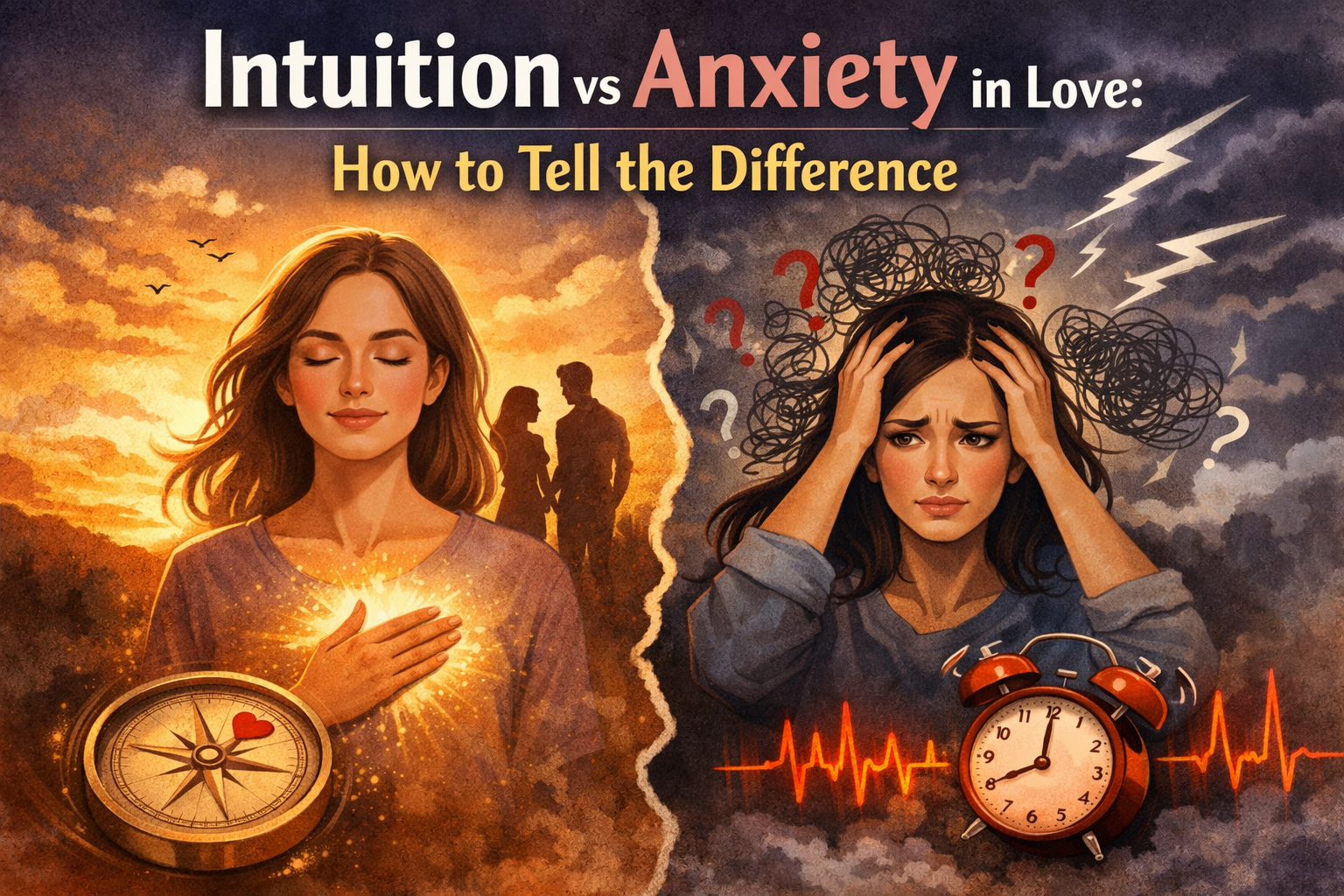
If you keep asking, “Is this my intuition or my anxiety in love?” you are not confused. You are discerning. Searches for “intuition vs anxiety in relationships” and “how to know if it’s anxiety or a gut feeling” keep rising because more people want clarity, not fantasy. You want to trust yourself. You want to stop spiraling. You want to know whether your body is protecting you or sabotaging you.
This guide breaks down the real differences between intuition and anxiety in love. You will learn how each one feels in your body, how each one speaks in your thoughts, and how to test which voice you are hearing. You will also see client examples so you can recognize your own patterns faster.
If you have read 7 Signs a Relationship Isn’t Emotionally Safe (Your Body Already Knows) this post builds on that foundation. That article focuses on body-based safety signals. This one sharpens your discernment so you stop mistaking fear for wisdom or chemistry for destiny.
Let’s get clear.
Why This Distinction Changes Everything
When you confuse anxiety for intuition, you sabotage healthy love.
When you ignore intuition and label it anxiety, you stay in unsafe dynamics.
Both mistakes cost you time, energy, and emotional stability.
Anxiety reacts to perceived threat.
Intuition responds to truth.
Anxiety escalates.
Intuition clarifies.
Anxiety loops.
Intuition lands.
You do not need to become calmer to hear intuition. You need to learn its tone.
What Intuition in Love Actually Feels Like
Intuition does not scream. It does not chase. It does not beg for reassurance.
It feels clean.
You notice:
• A steady inner knowing
• A calm but firm boundary
• A quiet sense of “this is not for me” or “this is aligned”
• Clarity without urgency
• Discomfort without panic
Your body may feel:
• Grounded
• Expanded in the chest
• Clear in the stomach
• Still
Intuition often arrives once. It does not argue with you. It does not flood you with worst case scenarios. It offers a statement.
“This is not safe.”
“This feels steady.”
“You are shrinking.”
“Something is off.”
Then it waits.
Client Example: Calm Clarity
Maria met someone who checked every box on paper. Strong chemistry. Shared goals. Daily communication. Yet on their third date, he made a subtle joke about her career being “cute.”
She laughed it off. Later that night, she felt a simple sentence inside her.
“He does not respect your ambition.”
No panic. No racing heart. No catastrophic thinking. Just that sentence.
She tried to dismiss it as anxiety. She liked him. She wanted it to work. But over the next two weeks, he made more comments that minimized her drive.
Her intuition spoke once. Anxiety tried to rationalize it.
She ended it early. No drama. No explosion. Just clarity.
Six months later, she met someone who celebrated her growth. That felt different in her body. Open. Encouraging. Safe.
Intuition felt steady both times. It did not spiral.
What Anxiety in Love Actually Feels Like
Anxiety feels loud. It feels urgent. It feels repetitive.
You notice:
• Constant overthinking
• Replaying conversations
• Fear of abandonment
• Sudden mood shifts based on texting patterns
• A need for immediate reassurance
Your body may feel:
• Tight chest
• Knotted stomach
• Restlessness
• Insomnia
• A surge of adrenaline
Anxiety speaks in questions, not statements.
“What if they leave?”
“What if I said too much?”
“What if they found someone better?”
“What if I ruin this?”
It pushes you to act fast. Text again. Apologize again. Check their social media. Pull tarot again. Google signs again.
Anxiety wants certainty. Intuition wants alignment.
Client Example: Spiral Mode
Danielle started dating someone consistent and kind. He texted daily. He planned dates. He followed through.
One evening, he took four hours to respond. Danielle’s chest tightened. Her thoughts raced.
“He’s losing interest.”
“He met someone else.”
“I should not have opened up.”
She drafted three texts. She deleted them. She cried.
The next morning, he explained he had back to back meetings and sent her a voice note saying he missed her.
Her anxiety created a story. Her intuition never told her he was unsafe. Her nervous system reacted to old abandonment wounds.
Once she learned to pause before reacting, her relationship stabilized.
Five Core Differences Between Intuition and Anxiety
- Intuition is brief. Anxiety is repetitive.
If the message loops for hours, that is anxiety. Intuition does not need repetition to feel true. - Intuition feels grounded. Anxiety feels urgent.
Urgency often signals fear, not wisdom. - Intuition does not require proof. Anxiety hunts for it.
Anxiety searches texts for hidden meaning. Intuition already knows. - Intuition brings peace, even if the decision feels hard.
Anxiety brings temporary relief after reassurance, then spikes again. - Intuition aligns with your values. Anxiety fixates on losing someone.
Ask yourself:
Are you afraid of losing the person, or are you concerned about losing yourself?
How Trauma Blurs the Signal
If you experienced emotional inconsistency, betrayal, or sudden loss, your nervous system scans for danger.
Your body learned that closeness equals risk.
So when you start to care about someone, your system activates.
This does not mean your intuition is broken. It means your threat detector is sensitive.
That is why grounding matters.
In 7 Signs a Relationship Isn’t Emotionally Safe (Your Body Already Knows) , we explored how your body signals relationship safety. If your body feels chronically tense, small, or braced around someone, that often points to misalignment. If your body relaxes once you regulate yourself, anxiety likely triggered the response.
You must regulate before you interpret.
The 4 Step Discernment Test
Use this process before making decisions.
Step 1. Regulate your body.
Breathe slowly for two minutes. Place one hand on your chest and one on your stomach. Let your heart rate settle.
Step 2. Remove the immediate trigger.
Put your phone down. Stop rereading messages. Create space.
Step 3. Ask one clean question.
“If I were not afraid of losing them, what would I see clearly?”
Step 4. Listen for the first calm answer.
Do not analyze it. Notice it.
If the answer feels simple and steady, that is intuition.
If a wave of new fears floods in, that is anxiety reacting.
Chemistry Is Not Intuition
High intensity does not equal alignment.
Many people confuse:
• Obsession with destiny
• Push pull dynamics with soul connection
• Emotional chaos with depth
Intuition feels clear even in attraction. Anxiety spikes in unpredictability.
Client Example: Intensity Trap
Lena felt electric chemistry with someone emotionally unavailable. Their conversations ran deep. Their connection felt fated.
She also felt constant anxiety. Waiting for texts. Wondering where she stood. Feeling highs and lows.
She called it intuition. She said, “I just know this is important.”
When she slowed down and regulated, her body revealed something else.
She felt exhausted. Drained. On edge.
Her intuition said, “This is familiar, not safe.”
Familiar often mirrors old patterns. Safe feels new.
The Body Does Not Lie
Your mind rationalizes. Your body signals.
If you feel:
• Tight jaw
• Clenched stomach
• Shallow breathing
• Constant vigilance
You are not relaxed.
Healthy love allows exhale.
This does not mean you never feel nerves. Early attraction brings excitement. But over time, your baseline should feel steadier, not more chaotic.
When Anxiety Masquerades as Intuition
Anxiety loves to wear spiritual language.
It says:
“I have a bad feeling.”
“Something is off.”
“I just know they will leave.”
Then it pushes you to test, control, or withdraw.
True intuition does not demand you control someone. It guides you to protect yourself.
If your “gut feeling” requires them to change behavior immediately so you can calm down, anxiety drives the reaction.
If your gut feeling guides you to set a boundary calmly, intuition leads.
Rebuilding Self Trust
You strengthen discernment through practice.
Start small.
Notice:
• Who leaves you feeling expanded
• Who leaves you feeling contracted
• When you feel most secure
• When you feel most hyper aware
Track patterns for 30 days.
You will see consistency.
Authority Comes From Pattern Recognition
After years of readings and client sessions, one pattern stands out.
People doubt intuition in calm relationships.
They romanticize anxiety in unstable ones.
Your nervous system might mistake chaos for passion if you grew up around unpredictability.
Safe love feels slower. It feels less dramatic. It feels steady.
Some people call that boring. In truth, it is regulated.
How to Strengthen Intuition in Love
• Prioritize sleep
• Reduce caffeine if you feel wired
• Journal before texting during conflict
• Delay emotional decisions by 24 hours
• Practice saying, “I need time to think”
Clarity rises when your system feels safe.
Questions to Ask Before Reacting
• Am I reacting to this moment or to a past wound?
• Does this person show consistent behavior over time?
• What evidence supports my fear?
• What evidence contradicts it?
• Do I feel small around them?
Intuition protects your integrity. Anxiety protects your fear of abandonment.
Discernment Creates Peace
When you learn the difference, you stop chasing reassurance. You stop gaslighting yourself. You stop labeling every discomfort as destiny.
You build relationships from grounded awareness, not panic.
If you notice chronic tension around someone, revisit the safety markers outlined in Your Body Knows Before Your Mind Does: Signs a Relationship Isn’t Safe. That framework helps you evaluate patterns, not isolated moments.
Love should challenge you to grow. It should not destabilize your identity.
Final Integration
You do not need to eliminate anxiety to experience love. You need to recognize it without obeying it.
Intuition speaks in clarity.
Anxiety speaks in fear.
One expands you.
One contracts you.
Pause before reacting.
Regulate before deciding.
Observe patterns over time.
The goal is not perfection. The goal is alignment.
When you trust the quiet voice instead of the loud one, your relationships change.
And so does your peace.
