
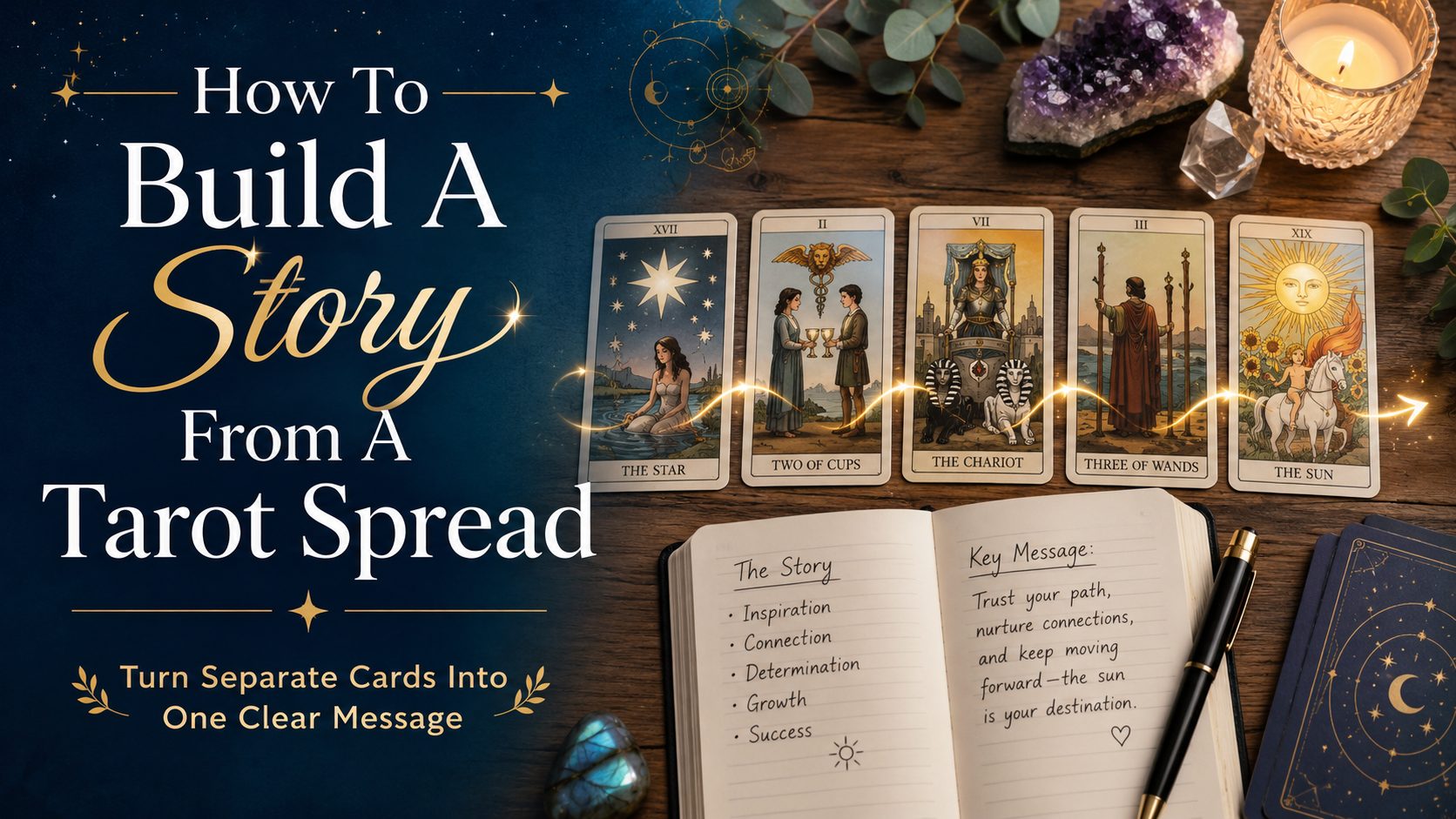
You lay out your tarot cards, study each image, and recognize every individual meaning.
Then something frustrating happens.
You still have no idea what the spread is trying to tell you.
One card speaks about love. Another points toward conflict. A third suggests movement. The next one looks like an ending. Suddenly, your reading feels like five separate messages instead of one clear answer.
Learning individual tarot card meanings is only the beginning of becoming a stronger reader.
Real interpretation starts when you understand how the cards work together.
A tarot spread tells a story.
Each card adds information about the situation, emotions, challenges, choices, motivations, and likely direction. Your job as a reader involves connecting those pieces until one central message starts to form.
Once you learn how to build a story from a tarot spread, readings begin feeling more natural. You stop trying to force every possible meaning into your interpretation. Instead, you start noticing patterns, relationships, emotional shifts, and the progression taking place across the cards.
This skill also helps you trust yourself.
Rather than wondering whether you remembered every textbook definition correctly, you start reading what appears in front of you.
If you feel stuck trying to understand a complicated relationship, emotional situation, or life decision, a private psychic reading gives you personalized insight into the energy surrounding your situation. Book a private psychic reading with me when you need deeper clarity about what your cards or intuition are showing you.
What Does It Mean to Build a Story From a Tarot Spread?
Building a story means reading the spread as one connected message instead of treating every tarot card like an isolated definition.
Think about a simple three-card relationship spread.
You pull:
Six of Cups
Five of Cups
Eight of Cups
Reading each card separately gives you three meanings.
Six of Cups often represents memories, nostalgia, emotional history, or someone from the past.
Five of Cups relates to disappointment, sadness, regret, and focusing on what went wrong.
Eight of Cups shows emotional withdrawal, leaving something behind, or searching for something more fulfilling.
Looking at each card individually gives useful information.
Reading them together gives a story.
A past emotional connection still holds meaning. Sadness or regret surrounds what happened. Despite those memories, someone appears to be emotionally pulling away.
Notice how much clearer the reading becomes once the cards connect.
The spread now has movement.
It begins with the past, moves through grief, and ends with departure.
Instead of saying, “Someone misses you because Six of Cups appeared,” you recognize the remaining cards change the interpretation.
Nostalgia exists, yet nostalgia does not always lead to reconciliation.
This difference matters.
Why Tarot Readers Get Stuck Reading Spreads
Most beginners spend a great deal of time memorizing card meanings.
Learning those meanings gives you a foundation.
Problems begin when memorization becomes the entire reading process.
Suppose you pull five cards.
Your mind immediately starts listing every possible definition.
The Fool means beginnings.
Two of Swords means indecision.
Three of Swords means heartbreak.
Six of Swords means moving forward.
The World means completion.
Each statement makes sense on its own.
Yet your client did not ask for five separate tarot definitions.
They asked a question.
Your reading needs to answer it.
Strong tarot interpretation requires you to move from card definitions toward the overall message.
Instead of asking, “What does this card mean?”
Ask, “What role is this card playing inside this story?”
One question changes your entire approach.
Start With the Question Before Reading the Cards
Every strong tarot story begins with a clear question.
A vague question often produces a confusing interpretation because you have no clear framework for reading the spread.
For example, compare these questions:
“What is going on?”
“What is developing between me and Eric over the next three months?”
The second question gives you context.
Now each card relates to the development of one relationship during a specific period.
Clear questions also help prevent your mind from wandering into unrelated meanings.
Imagine someone asks about their career.
The Lovers appears.
Without context, you might immediately think about romance.
Inside a career reading, The Lovers often points toward an important choice, partnership, agreement, or decision aligned with personal values.
Context changes interpretation.
Always return to the original question whenever a spread starts feeling confusing.
Find the Main Theme of the Spread
Before interpreting every card, look at the spread as a whole.
Notice what stands out.
Are most cards emotional?
Do several cards involve conflict?
Does the spread contain several Major Arcana cards?
Are Pentacles dominating the reading?
Does the spread move from difficult cards toward supportive cards?
These clues reveal the central theme before you start analyzing details.
For example, imagine a client named Melissa asks about her relationship with David.
Her spread contains:
Two of Cups
The Devil
Nine of Swords
Four of Pentacles
Eight of Cups
Several emotional themes appear immediately.
Two of Cups shows connection.
The Devil points toward attachment, unhealthy patterns, temptation, control, or difficulty breaking free.
Nine of Swords reveals worry.
Four of Pentacles shows holding on.
Eight of Cups introduces emotional withdrawal.
Before discussing individual cards, you already see a relationship involving emotional attachment, anxiety, difficulty letting go, and eventual movement away from the situation.
The spread has a strong theme.
Attachment sits at the center of the story.
Identify the Beginning, Middle, and Direction
Stories usually have progression.
Tarot spreads often work the same way.
Ask yourself three questions.
Where does the energy begin?
What develops in the middle?
Where does the energy appear to be heading?
Even without assigned positions, cards often create an energetic sequence from left to right.
Suppose you pull:
Five of Pentacles
Strength
Ace of Pentacles
A clear progression appears.
Five of Pentacles starts with struggle, insecurity, loss, or feeling unsupported.
Strength brings emotional control, patience, resilience, and inner steadiness.
Ace of Pentacles introduces a new practical opportunity.
The story moves from hardship toward regaining stability and opening a new door.
You do not need an elaborate interpretation.
Simple connections often produce the strongest readings.
Look at What Changes From One Card to the Next
Transition matters.
One useful tarot technique involves asking what changes between neighboring cards.
Consider this sequence:
Four of Swords
Page of Wands
The Chariot
Four of Swords begins with rest, withdrawal, contemplation, or inactivity.
Page of Wands introduces curiosity, communication, inspiration, or renewed enthusiasm.
The Chariot pushes the energy into movement and action.
Something shifts.
Stillness turns into interest.
Interest turns into action.
Recognizing this progression gives you a story instead of three definitions.
Whenever you feel stuck, ask:
“What changed?”
“What caused the energy to shift?”
“Did the situation become stronger or weaker?”
“Did someone move closer or farther away?”
“Did communication increase or stop?”
Those questions bring the spread to life.
Pay Attention to Repeating Tarot Suits
Tarot suits give important clues about where the story is focused.
Cups relate strongly to emotions, relationships, intuition, connection, and feelings.
Swords often involve thoughts, communication, conflict, worry, truth, decisions, and mental activity.
Pentacles usually connect with money, work, security, physical matters, stability, and long-term investment.
Wands often represent attraction, motivation, passion, action, ambition, creativity, and momentum.
A spread filled with Cups has a different emotional tone from one filled with Swords.
Imagine someone asks, “How does Brian feel about me?”
You pull:
Eight of Swords
Two of Swords
King of Swords
Four of Swords
Ten of Swords
Notice the lack of Cups.
Rather than reading this as a highly emotional spread, you see someone heavily inside their own thoughts.
Mental pressure dominates.
Indecision appears.
Emotional expression looks limited.
Withdrawal follows.
Ten of Swords suggests a painful mental conclusion, exhaustion, or feeling as if the situation has reached its limit.
The absence of Cups becomes part of the reading.
Notice When One Suit Is Missing
Missing energy deserves attention too.
Suppose a relationship reading has Wands, Swords, and Pentacles but no Cups.
Attraction might exist.
Communication might exist.
Practical connections might exist.
Emotional intimacy might still be missing.
Another spread might contain Cups and Wands without Pentacles.
Feelings and attraction appear strong, while long-term stability lacks support.
Use missing suits carefully.
Absence does not automatically mean something negative.
Instead, treat it as one more clue.
Watch the Major Arcana Cards
Major Arcana cards often reveal deeper themes or major turning points.
When several Major Arcana cards appear together, the situation usually carries greater emotional or personal significance.
Imagine someone asks whether their current job situation is changing.
The spread shows:
Eight of Pentacles
Judgement
Death
The Fool
Three of Wands
Judgement suggests an important realization or decision.
Death points toward a major transition or ending.
The Fool introduces a fresh beginning.
Three of Wands looks toward future expansion.
A strong story forms.
Work has been continuing as usual, yet an awakening or decision creates change. An old professional chapter starts closing. A new path opens. Future plans begin expanding beyond the present situation.
Three Major Arcana cards appearing together make the transition difficult to ignore.
Use Court Cards as Characters, Energy, or Behavior
Court cards often confuse tarot readers because they have several possible roles.
A King, Queen, Knight, or Page might represent a person.
Another reading might use the same card to describe behavior.
Some spreads show a court card as an emotional approach or personality trait.
Context tells you which interpretation fits.
Suppose Jennifer asks about a new person named Chris.
Her cards are:
Knight of Cups
Seven of Cups
Knight of Wands
Two of Pentacles
Page of Cups
The first Knight appears romantic.
Seven of Cups introduces uncertainty or several possibilities.
Knight of Wands brings strong attraction, excitement, and inconsistent momentum.
Two of Pentacles shows juggling.
Page of Cups ends with emotional interest, yet the Page offers less maturity than a King or Queen.
The story suggests romantic attraction and emotional curiosity.
Consistency looks weaker.
Chris might enjoy pursuing the connection while still figuring out what he wants.
Reading every court card as a separate person would make this spread confusing.
Reading them as behavior creates a stronger interpretation.
Let the Cards Modify Each Other
Neighboring tarot cards influence interpretation.
This principle becomes important when one card seems positive and the next card looks challenging.
Take the Sun.
Most tarot readers associate the Sun with happiness, clarity, success, warmth, and positive outcomes.
Now place the Sun beside Five of Cups.
Suddenly the message becomes more layered.
Someone might gain clarity about a disappointment.
Healing might begin after sadness.
A situation might contain happiness mixed with regret.
Context prevents overly simplistic readings.
Another example uses Two of Cups next to Ten of Swords.
Two of Cups alone looks like partnership and mutual connection.
Ten of Swords changes the story.
A meaningful connection might have reached a painful ending.
Mutual feelings do not automatically guarantee a relationship continues.
Reading combinations protects you from giving false hope based on one attractive card.
Stop Letting One Positive Card Control the Entire Spread
Hopeful cards often grab attention.
The same issue happens with frightening cards.
Neither should control the reading.
Imagine a client named Stephanie asks whether she and Michael will reconcile.
She pulls:
Six of Cups
Five of Cups
Two of Swords
Eight of Cups
The World
Six of Cups immediately brings memories and the past into the reading.
Someone still thinks about what happened.
Five of Cups adds sadness and regret.
Two of Swords shows uncertainty or avoidance.
Eight of Cups points toward emotional departure.
The World brings completion.
Reading Six of Cups alone might lead someone to say, “Yes, Michael misses you, so he will return.”
The full spread tells a different story.
Memories remain.
Emotional history still matters.
Sadness surrounds the connection.
Indecision continues.
Movement gradually heads toward leaving the situation behind.
Completion becomes the final theme.
One hopeful card does not erase four cards showing emotional closure.
Stop Letting One Difficult Card Frighten You
The opposite problem happens when cards such as Death, The Tower, Ten of Swords, or Three of Swords appear.
A difficult card does not automatically mean disaster.
Look at what surrounds it.
Suppose you pull:
The Tower
Ace of Swords
Six of Swords
The Star
The Tower starts with disruption or a sudden realization.
Ace of Swords brings truth and clarity.
Six of Swords moves away from difficulty.
The Star follows with healing, hope, and renewal.
The story is not simply, “Something terrible happens.”
A sudden event or realization breaks through an unstable situation. Truth becomes impossible to ignore. Movement away from stress begins. Healing follows.
The cards after The Tower completely change how you understand its purpose in the spread.
Read Reversals as Part of the Story
Reversed cards add another layer.
Avoid treating every reversal as the complete opposite of the upright meaning.
A reversed card might represent blocked energy, delay, internal struggle, imbalance, avoidance, weakness, or difficulty expressing the upright energy.
Suppose your spread includes:
Ace of Cups
Two of Cups
Knight of Cups reversed
Four of Swords
The emotional connection begins strongly.
Ace of Cups brings feelings.
Two of Cups shows mutual connection.
Knight of Cups reversed introduces difficulty expressing those emotions or following through romantically.
Four of Swords moves toward silence or withdrawal.
The story suggests feelings exist, yet emotional expression becomes blocked.
Silence follows.
That interpretation feels more complete than saying, “Knight of Cups reversed means no love.”
Follow Emotional Momentum
Every spread has momentum.
Some spreads build.
Others weaken.
A few move back and forth.
Watch whether the energy increases, decreases, pauses, or changes direction.
Consider:
Page of Wands
Knight of Wands
King of Wands
Momentum grows.
Energy matures.
Confidence strengthens.
Now reverse the order:
King of Wands
Knight of Wands
Page of Wands
Energy becomes less stable.
Confidence might turn into impulsiveness.
A strong beginning might lose maturity over time.
Card order matters.
Look for Repeating Numbers
Numbers often reveal patterns.
Two frequently connects with choices, partnerships, duality, or balance.
Three often relates to growth, collaboration, expansion, or social dynamics.
Four often points toward structure, security, stability, or restriction.
Five frequently introduces change, disruption, conflict, or adjustment.
Six often brings movement toward harmony, support, recovery, or transition.
Seven tends to involve assessment, uncertainty, strategy, or testing.
Eight often focuses on movement, power, mastery, restriction, or development depending on the suit.
Nine frequently reflects nearing completion.
Ten often marks the end of a cycle.
Suppose your spread contains Two of Cups, Two of Swords, and Two of Pentacles.
Partnership exists.
A decision appears unresolved.
Someone is trying to balance competing priorities.
The repeating twos emphasize choice and duality.
Numbers help strengthen themes already present.
Notice Visual Connections Between Cards
Artwork adds information beyond keywords.
Look at where figures are facing.
Notice whether people look toward each other or away from one another.
Study repeated colors, symbols, weather, animals, water, mountains, roads, buildings, and objects.
Robin Wood Tarot works especially well for this type of storytelling because the images contain expressive body language and rich symbolism.
Suppose two people on neighboring cards appear to face away from each other.
Emotional distance might become part of the message.
Another pair might appear visually connected through matching colors or similar posture.
Your intuition might notice the connection before your logical mind explains it.
Trust what your eyes pick up.
Find the Turning Point
Longer spreads often contain one card where the energy changes.
Finding this card makes storytelling easier.
Imagine this seven-card spread:
Nine of Swords
Five of Cups
Four of Pentacles
Death
Ace of Wands
Three of Wands
The Sun
The first three cards feel heavy.
Anxiety appears.
Sadness follows.
Holding on continues.
Death becomes the turning point.
After Death, Ace of Wands introduces fresh energy.
Three of Wands looks toward the future.
The Sun brings clarity and optimism.
Instead of treating Death as a frightening card, you recognize its role.
The ending clears space for the next chapter.
Identify the Strongest Card in the Spread
Certain cards carry more weight because of their position, symbolism, repetition, or relationship to the question.
The strongest card does not always appear first.
Sometimes one card explains every other card around it.
Suppose someone asks why communication stopped.
You pull:
Page of Cups
Seven of Swords
The Hermit
Eight of Wands reversed
Two of Swords
The Hermit might become the central card.
Withdrawal sits in the middle of the spread.
Seven of Swords before it suggests avoidance or private behavior.
Eight of Wands reversed after it shows stalled communication.
Two of Swords ends with indecision.
The surrounding cards reinforce The Hermit’s theme.
Someone appears to be intentionally pulling inward rather than moving communication forward.
Separate Feelings From Actions
One of the biggest mistakes in relationship tarot involves treating feelings and actions as the same thing.
Someone might have strong feelings without taking action.
Someone else might communicate frequently without offering emotional commitment.
Tarot spreads often show this difference clearly.
For example:
King of Cups
Eight of Swords
Four of Pentacles
Knight of Pentacles reversed
King of Cups suggests deep emotion or emotional awareness.
Eight of Swords shows feeling mentally trapped.
Four of Pentacles reveals holding back.
Knight of Pentacles reversed shows stalled progress.
The story does not say, “He feels deeply, so he is coming forward.”
Instead, the spread suggests emotional depth exists alongside fear, restriction, and lack of movement.
Understanding this distinction makes relationship readings far more accurate.
Ask What the Cards Are Doing Instead of Only What They Mean
Action words make tarot interpretation stronger.
Rather than saying:
“Eight of Cups means leaving.”
Try:
“Someone is emotionally pulling away.”
Instead of:
“Two of Swords means indecision.”
Use:
“Someone keeps avoiding a decision.”
Rather than:
“Page of Wands means a message.”
Say:
“Curiosity starts bringing communication back into the situation.”
Action creates movement.
Movement creates story.
Turn Keywords Into Complete Thoughts
Keywords help when learning tarot.
Eventually, you want to turn them into sentences.
Suppose your keywords are:
Three of Swords = heartbreak
Hermit = isolation
Star = healing
Rather than giving three definitions, connect them.
“Heartbreak led someone into a period of emotional withdrawal, yet healing now appears to be taking place.”
One sentence tells the entire story.
Your interpretation sounds more natural because you are reading the progression.
Use Cause and Effect
Cause and effect creates powerful tarot stories.
Ask yourself:
“What caused this card?”
“What happened because of this card?”
Consider:
Seven of Swords
The Tower
Ace of Swords
If Seven of Swords relates to secrecy or avoidance, The Tower might reveal what happens when hidden information becomes impossible to maintain.
Ace of Swords then brings truth.
Your story becomes:
“Avoidance or secrecy creates instability. Something exposes the problem. Truth follows.”
Simple cause and effect turns three cards into one clear message.
Pay Attention to Contradictions
Tarot spreads sometimes contain opposite energies.
Contradictions often reveal internal conflict.
Imagine:
Two of Cups
Four of Pentacles
Eight of Cups
Someone feels connected.
Someone also holds back.
Eventually, withdrawal appears.
Those cards are not fighting each other.
They describe emotional conflict.
A person might care deeply while still believing distance is necessary.
Real people often experience conflicting feelings.
Your tarot readings become stronger when you allow emotional complexity.
Use the Final Card as Direction, Not a Guaranteed Fate
Readers often treat the last card like a fixed prediction.
A better approach involves seeing it as the direction created by current energy.
Suppose the final card is Eight of Cups.
Current behavior appears to be moving toward emotional distance.
If circumstances change, choices might change too.
Tarot reflects patterns, energy, motivations, and likely developments.
People still make decisions.
Viewing the final card as direction keeps your readings practical and grounded.
Tell the Story in Plain Language
Good tarot interpretation does not need complicated spiritual language.
Simple language often gives the strongest message.
Suppose your spread contains:
Queen of Cups
Three of Swords
Four of Swords
Judgement
Ace of Pentacles
A natural interpretation might sound like this:
“You still care deeply about what happened, yet the heartbreak pushed you into a period of withdrawal. During this quiet phase, you start realizing what the experience taught you. Once you accept what needs to change, a new opportunity for greater stability begins opening.”
Anyone understands this message.
Your reader does not need to know every tarot definition.
They need to understand the story.
A Five-Step Method for Building a Tarot Story
Use this method whenever a spread feels confusing.
Step 1: Read the Question Again
Return to what you asked.
Keep every card connected to the question.
Step 2: Look at the Entire Spread
Notice suits, Major Arcana cards, reversals, numbers, emotional tone, and repeated themes.
Avoid interpreting yet.
Observe first.
Step 3: Find the Main Storyline
Identify where the spread begins, where the energy changes, and where it appears to be heading.
Step 4: Connect Neighboring Cards
Ask how each card modifies the next one.
Look for cause, effect, tension, movement, or progression.
Step 5: Say the Message Without Naming the Cards
This final step tests whether you understand the reading.
Imagine explaining the spread to someone who knows nothing about tarot.
If your explanation still makes sense, you found the story.
Full Example: Reading a Relationship Spread as a Story
Imagine a client named Amanda asks:
“Where is my relationship with Daniel heading?”
She pulls:
Two of Cups
Nine of Wands
The Moon
Ace of Swords
Six of Swords
First, look at the overall theme.
Two of Cups establishes an emotional connection.
Nine of Wands introduces defensiveness or exhaustion.
The Moon creates uncertainty.
Ace of Swords brings clarity.
Six of Swords moves away from turbulence.
Now build the story.
Amanda and Daniel share a meaningful connection. Emotional walls have started building after repeated stress. Confusion or uncertainty makes the relationship harder to understand. A direct conversation or realization eventually brings greater clarity. From there, the relationship needs to move away from its current emotional tension.
Notice how the interpretation does not automatically promise a breakup or reconciliation.
The cards show a process.
Connection exists.
Defensiveness interferes.
Uncertainty grows.
Truth enters.
Movement follows.
The reading now answers the question instead of listing meanings.
If your own relationship spread leaves you wondering what someone feels, why communication changed, or where the connection is heading, a private psychic reading with me gives you a personalized interpretation based on your situation. Book your private reading when you want direct insight into the emotional patterns and next steps surrounding your connection.
Full Example: Reading a Career Spread as a Story
Imagine Marcus asks:
“What is developing with my career over the next six months?”
His spread shows:
Eight of Pentacles
Ten of Wands
Judgement
The Fool
Three of Pentacles
Eight of Pentacles begins with hard work.
Ten of Wands shows pressure and responsibility.
Judgement brings realization.
The Fool opens a new path.
Three of Pentacles brings collaboration, skill building, and professional growth.
The story becomes clear.
Marcus has been working hard, yet his current responsibilities are becoming exhausting. A major realization pushes him to reconsider his professional direction. New opportunities start appearing once he becomes willing to explore something different. Working with new people or developing his skills plays an important role in the next stage.
This reading has a beginning, conflict, turning point, new direction, and outcome.
Full Example: Reading a Communication Spread
Imagine Rachel asks:
“Why has Alex stopped communicating with me?”
She pulls:
Page of Cups
Seven of Swords
Four of Swords
Two of Swords
Knight of Pentacles reversed
Page of Cups suggests emotional interest or softer communication existed.
Seven of Swords introduces avoidance.
Four of Swords shows retreat.
Two of Swords reveals indecision.
Knight of Pentacles reversed ends with stagnation.
The story becomes:
“Interest existed, yet Alex started avoiding something he did not want to face directly. Instead of discussing the issue, he withdrew. He now appears stuck between choices and is not making steady progress toward reopening communication.”
Notice what this reading does not say.
It does not assume Alex feels nothing.
It also does not promise contact simply because Page of Cups appeared.
The spread shows interest mixed with avoidance and stagnation.
What to Do When the Cards Still Do Not Make Sense
Occasionally, a spread feels confusing even after using every technique.
Stop pulling more cards.
Extra cards often create more confusion.
Return to the original spread.
Look for the simplest message.
Ask yourself:
“What theme repeats most?”
“What emotional direction appears strongest?”
“Which card seems to explain the problem?”
“Where does the energy change?”
“What happens at the end?”
Give yourself permission to read simply.
Tarot does not reward complicated interpretations.
Clarity matters more than showing how much you know.
Avoid Pulling Clarifier After Clarifier
Clarifying cards have a purpose.
Overusing them creates clutter.
Suppose you pull Seven of Swords and immediately feel uncomfortable.
You pull a clarifier.
Then another.
Then three more.
Before long, a five-card spread becomes fifteen cards.
The original story disappears.
Try interpreting the first spread completely before adding anything.
If one card still needs explanation, pull one clarifier with a specific question.
For example:
“What is the Seven of Swords describing in this situation?”
A focused clarifier gives useful information.
Random extra cards rarely improve clarity.
Read What You See Instead of What You Want
Personal readings become difficult when emotions get involved.
Someone hoping for reconciliation might turn every positive card into proof an ex is returning.
Another person fearing rejection might interpret every challenging card as permanent loss.
Return to the pattern.
Suppose your reading includes:
Six of Cups
Page of Cups
Four of Swords
Eight of Cups
The World
Memories and emotional interest appear in the beginning.
Silence follows.
Emotional withdrawal develops.
Completion closes the spread.
Wanting reconciliation does not change the progression.
The spread asks you to respect the entire message.
Emotional objectivity takes practice.
Learn to Separate Intuition From Wishful Thinking
Intuition tends to feel direct.
Wishful thinking keeps negotiating.
You might look at a spread and immediately sense, “This person still cares, but they are not ready to act.”
Then your mind starts searching for a different answer.
“What if Page of Cups means they text tomorrow?”
“What if Six of Cups means they come back?”
“What if The Star guarantees reconciliation?”
The original intuitive impression often becomes buried under emotional attachment.
Write your first impression down before researching meanings.
Return to it after studying the spread.
You might notice your first response captured the story more accurately than your later overthinking.
Practice With Small Spreads First
Large spreads are useful once you feel comfortable connecting cards.
Three-card spreads teach storytelling faster.
Try questions such as:
“What is happening now, what is influencing it, and where is it heading?”
“What does this person feel, what are they struggling with, and what are they likely to do?”
“What is blocking me, what needs to change, and what becomes possible afterward?”
Three cards give enough information to form a narrative without overwhelming you.
Once those stories feel natural, move toward five cards.
Eventually, larger spreads become easier because your mind automatically groups cards into themes.
Practice Telling the Story Without Tarot Vocabulary
One of my favorite exercises involves removing tarot language completely.
Pull five cards.
Study them.
Then explain the reading without mentioning card names.
For example, instead of saying:
“The Hermit followed by Judgement and Ace of Wands means…”
Say:
“You have spent time withdrawing from the situation. During this period, an important realization starts changing how you see your future. Fresh motivation follows once you decide what you want.”
This exercise teaches interpretation instead of memorization.
Write One Sentence for Every Three Cards
Another helpful practice involves grouping cards.
Take a six-card spread.
Read cards one through three as one sentence.
Read cards four through six as another sentence.
Then connect the two sentences.
Suppose you pull:
Five of Cups
Four of Swords
Strength
Ace of Wands
Three of Pentacles
The Sun
Cards one through three:
“Disappointment led to withdrawal, yet emotional strength is returning.”
Cards four through six:
“Renewed motivation leads toward productive opportunities and a more positive direction.”
Combined story:
“A period of disappointment caused you to pull back, yet you are rebuilding your confidence. As your energy returns, new opportunities involving work or collaboration start moving you toward a happier chapter.”
Six tarot cards have now become one flowing message.
Ask Yourself What the Client Needs to Understand
A strong reading gives more than prediction.
Insight matters.
Suppose someone asks whether an ex will return.
The spread might reveal attachment, avoidance, repeated conflict, and emotional exhaustion.
Even if future communication appears, the deeper message might involve understanding why the cycle keeps repeating.
Ask:
“What is the most important thing this person needs to know?”
This question often reveals the heart of the reading.
Your Tarot Story Should Answer the Original Question
Before finishing any reading, return to the question one last time.
Did your interpretation answer it?
If someone asks, “How does Jessica feel about me?” avoid spending most of the reading discussing Jessica’s career.
If someone asks, “Will this job offer move forward?” keep the interpretation focused on progress, delays, decisions, communication, and outcome.
Staying focused makes your readings feel clearer and more professional.
How Storytelling Improves Your Tarot Readings
Reading tarot as a story changes the experience.
Your interpretations become easier to follow.
Conflicting cards start making sense.
Reversals feel less confusing.
Court cards become easier to place.
Major Arcana cards reveal turning points.
Suit patterns show where energy is concentrated.
Final cards show direction.
Most importantly, you stop depending entirely on memorized meanings.
Tarot begins feeling connected.
Instead of seeing five cards, you start seeing one message told through five pieces of information.
Questions to Ask Yourself During Every Tarot Spread
Keep these questions beside you while practicing:
What is the person asking?
What theme appears strongest?
Which suit dominates?
Which energy is missing?
Where does the story begin?
What changes between the cards?
Where is the turning point?
What emotions appear?
What actions appear?
Do feelings and actions match?
Which card carries the strongest message?
Does the energy improve, weaken, or stay stuck?
What does the final card suggest about direction?
How would I explain this spread without using tarot terminology?
What does the person most need to understand?
Answering these questions trains your mind to connect tarot cards naturally.
Final Thoughts on Building a Story From a Tarot Spread
Learning tarot involves more than memorizing seventy-eight definitions.
Each spread creates its own conversation.
One card introduces the issue.
Another reveals what complicates it.
A third exposes emotion.
The next card shows a decision.
Another points toward movement.
Together, those pieces tell the story.
Start by reading the question carefully.
Study the overall pattern.
Watch repeating suits and numbers.
Notice changes in emotional tone.
Look for the turning point.
Connect neighboring cards.
Follow the progression.
Most of all, trust the complete spread more than one isolated card.
Your readings become stronger when you stop asking, “What does every card mean?”
Begin asking, “What are these cards saying together?”
Once this approach becomes part of your practice, complicated spreads start feeling easier to understand. Your intuition has more room to work because you are no longer forcing each card into a separate definition.
If you are looking at a personal tarot spread and still feel unsure about the message, you do not have to keep pulling card after card searching for clarity. A private psychic reading with me gives you direct insight into the emotions, intentions, patterns, choices, and likely direction surrounding your situation.
Book your private psychic reading with me when you want clear answers and personalized guidance about love, relationships, career, life changes, or a situation which keeps leaving you with questions.
